


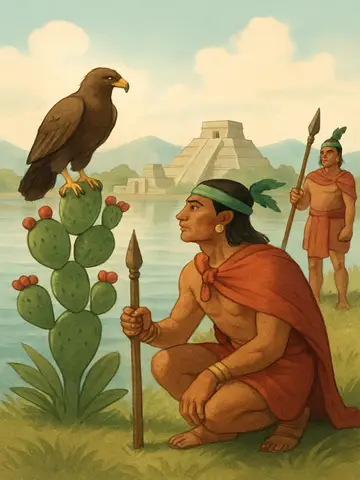
In 1428, the founding of the Aztec Empire marked a major turning point in Mesoamerican history. This formation of a triple alliance between Tenochtitlan, Texcoco and Tlacopan is part of a context of political rivalries and pre-colonial territorial reorganization that shape the region for a long time.
Historical and political context before the foundation of 1428
Prior to 1428, the Mexico Valley was dominated by several competing city-states, including the Azcapotzalco Tepanecs, which exercised regional hegemony. The Mexicana, a warrior people from the north, have just settled in the island of Tenochtitlan on Lake Texcoco, a strategic but fragile position. The rivalry between cities, exacerbated by the political and economic controls imposed by Azcapotzalco, creates a climate conducive to the emergence of a coalition to overthrow this domination and redistribute power in the valley.
Aztec Empire Foundation: actors and immediate consequences
The alliance in 1428 brought together the military and political forces of Tenochtitlan, Texcoco and Tlacopan to defeat Azcapotzalco. Directed by Itzcoatl, Emperor of Tenochtitlan, this coalition dethrones the Tepanecs and establishes a new structure of domination. The triple alliance becomes the basis of an expansionist empire, based on a centralized dependent system. The immediate consequences include the increase in Tenochtitlan's military and economic power, the consolidation of its regional influence, and the establishment of a network of vassal city-states that finance imperial expansion.
Issues and impacts
In the short term, the foundation of the Aztec Empire led to a war of expansion and a complex administrative organization centred on Tenochtitlan. In the long term, this empire builds one of the most powerful political systems in pre-Colombian America, fostering cultural development marked by religion, architecture and warrior art. This system will facilitate the ability to resist and adapt to the first European contacts in the 16th century.
Historical links
The foundation continues with the fall of the Mesoamerican classic cities such as Teotihuacan. It prepares the rise of the Mexican civilization which will culminate with Moctezuma II and the arrival of Cortés in 1519. This change of power also illustrates a classic model of empire formation by military alliances, comparable to the cities-states of the ancient Mediterranean. Finally, it precedes the radical transformation of the region after the Spanish conquest, which will end Aztec hegemony.