


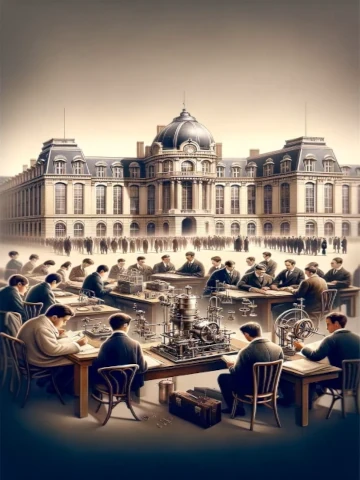
The creation of the École Polytechnique in 1794 marks a major turning point in the history of scientific and technical education in France. Founded in a revolutionary period, this institution embodies both the spirit of innovation and the desire to train engineers capable of meeting the industrial and military challenges of the nation. A review of the historical context and ambitions that led to the birth of this prestigious school.
Historical context of the foundation in 1794
The end of the 18th century was a period of profound upheaval in France. The French Revolution, initiated in 1789, upset the country's political, social and educational structures. In this tumultuous context, the need for a new form of scientific education becomes imperative, in particular to support the military and industrial efforts of the young Republic. The École Polytechnique was founded in 1794 by Lazare Carnot and other visionary revolutionaries, who wanted to form an elite of engineers capable of designing weapons, infrastructures and technical innovations essential for the defence and modernization of France. This foundation is also part of the desire to democratize education and break with the former aristocratic elites.
The objectives and ambitions of the Polytechnic
The École Polytechnique was conceived as a centre of scientific excellence both rigorous and innovative. Its founders wanted to build an institution capable not only of providing high-level theoretical education, but also of training practitioners able to apply this knowledge in various fields: engineering, mathematics, physics, artillery, and later in the economic and social sciences. The ambition was twofold: to contribute to the technical and scientific progress of the nation, but also to ensure the military and industrial superiority of France. To this end, the school favours teaching focused on applied mathematics and experimental sciences, by introducing a rigorous discipline and a spirit of innovation that still persists today.
The creation of the École Polytechnique in 1794 symbolizes the importance attached to scientific education in building a modern nation. Born in a revolutionary context, it has been able to impose itself as a pillar of technical and scientific excellence, forming generations of engineers and researchers who have brought France to the forefront of the world. Even today, its legacy bears witness to the crucial importance of science and technology in the development of a prosperous and innovative society.