

Historical and geopolitical context before 1438
Prior to 1438, the Andean region was divided into several chiefdoms and small kingdoms struggling for the control of resources and territories. The Incas, a people from the Cusco Valley, occupied a modest position within these entities. The Andean civilization had complex trade and cultural exchanges, especially with the wari and Tiwanaku civilizations that had disappeared a few centuries earlier, whose remains still influenced the political and religious organization. Moreover, the domination of neighboring kingdoms like the Chancas threatened local stability, pushing the Incas to strengthen their power. This period marks a transition to political centralization under the Inca dynasty, prelude to the formation of an empire.
Foundation and initial expansion of the Inca Empire
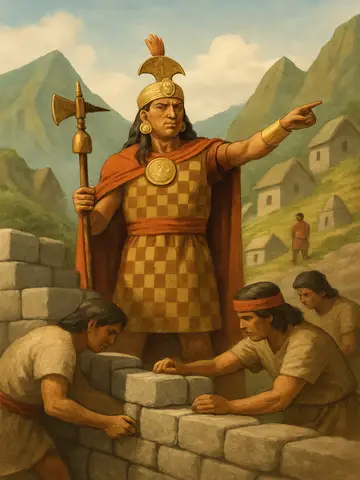
In 1438, Pachacútec, the ninth inca sovereign, reversed his rivals in a series of conflicts, notably against the Chancas. He thus established the official foundation of the Inca Empire (Tawantinsuyu), centralizing power in Cusco. Pachacútec organizes an effective administration, divides the territory into governor-led provinces and develops a road network to ensure control and communication. This rapid expansion is based on strategic alliances, military conquests and the gradual integration of peoples defeated by systems of reciprocity and redistribution. The foundation of the empire marks a major turning point in Andean history, transforming a confederation into a regional power.
The formation of the Inca Empire in 1438 under Pachacútec prepares the Andean domination until the Spanish conquest in the 16th century. This process finds its roots in previous conflicts with the Chancas and is part of the continuity of pre-Columbian state strategies. The established political and social organization influences the colonial structures and contemporary regional identities of the South American Andes.