


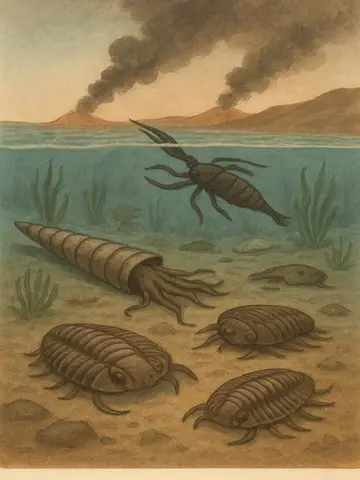
The Ordovician-Silurian extinction, which occurred about 444 million years ago, represents the second largest biological crisis in Earth's history. It marks the transition between the Ordovician and Silurian geological periods, profoundly affecting the marine biodiversity that dominated then. This extinction is intimately linked to major climate change and a reorganization of marine ecosystems.
Geological and biological context before extinction Ordovician-Silurian
At the end of Ordovician, the Earth was characterized by biodiversity-rich oceans, including trilobites, brachiopods, and graptolites, which formed the majority of marine species. The continents were grouped mainly around the equator, with the immense Gondwana continent extending towards the South Pole, favoring a warm and stable climate. However, this period experienced progressive cooling, coupled with the massive formation of glaciers on the Gondwana, causing a decline in sea levels and disturbance of marine habitats.
Consequences and impacts of extinction at -444 million years
The extinction eliminated about 85% of marine species, including large groups of trilobites and brachiopods. This decline was caused by abrupt cooling and a decline in sea level, reducing shallow coastal areas crucial for marine life. In the long term, this extinction has led to the diversification of surviving species, including fish growth and early forms of coral reefs in Silurian. It illustrates a major ecological rupture that precedes other events such as the Permien-Trias extinction and the Cambrian explosion, highlighting the importance of climatic variations in evolutionary dynamics.
The Ordovician-Silurien extinction testifies to the fragility of ecosystems in the face of climate change, highlighting a crucial step in the evolution of marine life and in the geological structure of our planet.