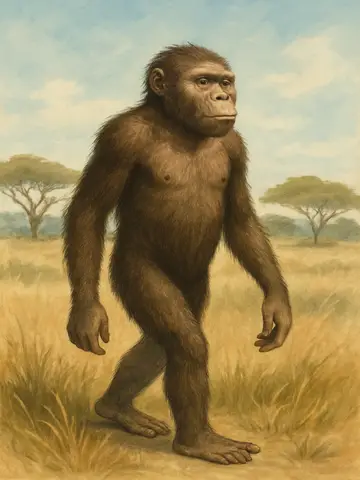
The appearance of australopitheques, about 4 million years ago, marks a crucial step in human evolution. This emergence is in a changing climate and ecological context in East Africa, where the first hominids began to develop distinctive features of the Homo genus.
Historical and environmental context of the Australopithèques apparition
4 million years ago, East Africa experienced a drier climate and landscapes dominated by sparse savannahs and forests. This environmental evolution forces some primates to adapt to a new habitat, favouring bipedia. Australopitheques thus appear as hominids able to walk standing while maintaining arboreal skills. This period directly precedes the emergence of the first stone tools about 2.6 million years ago, reflecting a transition to more complex lifestyles. The region remains politically and culturally unstructured, but this phase is essential in the evolutionary chain leading to Homo habilis and later Homo sapiens.
Evolving impact and major scientific implications
The appearance of australopitheques is a major turning point for paleoanthropology, as they represent the first clearly biped hominids and a direct link to modern humans. Their study allowed us to understand the morphological adaptations associated with bipedia, such as the shape of the pelvis and the lower limbs. These discoveries also revealed that the divergence between humans and chimpanzees occurred well before, about 5 to 7 million years ago. Australopitheques thus lay the basis for the subsequent appearance of the first Homo, contributing to the understanding of the mechanisms of natural selection and adaptation. Their discovery stimulates research on tools, brain development and social behaviour, forming a fundamental scientific basis for the study of human evolution.
The appearance of australopitheques 4 million years ago is a key step that sheds light on the complexity of human origins, linking environmental changes, biological adaptations and cultural innovations.