


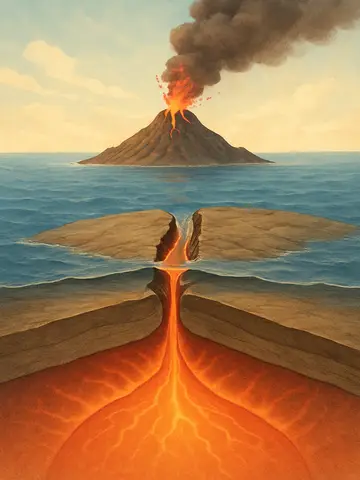
About 3 billion years ago, the primitive Earth underwent major transformations that led to the formation of the first oceanic tectonic plates. This phenomenon marks a turning point in the geological evolution of the planet, as it establishes the foundations of the present Earth's dynamics.
Origins of the first oceanic tectonic plates 3 billion years ago
The formation of the first oceanic tectonic plates dates back to the Archean, when the Earth was still in intense cooling. At that time, the rigid ocean lithosphere formed by progressive solidification of the surface magma, creating distinct rigid fragments capable of movement. These plates drifted on the more ductile asthenospheric, initiating the tectonic plates. This process was favoured by the intense degassing and formation of primitive oceans, which moderated crustal temperature and allowed its fragmentation. This mechanism is at the origin of the first stable ocean crust, foreshadowing the dynamics of the mid-ocean dorsal and subduction zones.
Geological impact and evolution of the primitive globe by oceanic tectonics
The appearance of oceanic tectonic plates has profoundly altered the structure and internal dynamics of the Earth. It promoted the formation of the first stable ocean basins, the recycling of the crust through subduction and the creation of underwater reliefs. This tectonic also accelerated the formation of continents by facilitating accretion and crustal differentiation. In direct connection with the progressive cooling of the Earth's core, these tectonic movements contributed to the appearance of a protective magnetic field. This event marks a major break after the formation of the Earth (4.5 Ga), the development of the first life forms (around 3.8 Ga), and precedes the formation of subsequent supercontinents like Rodinia (around 1 Ga). It is fundamental to understanding the current terrestrial dynamics and the evolution of planetary ecosystems.