


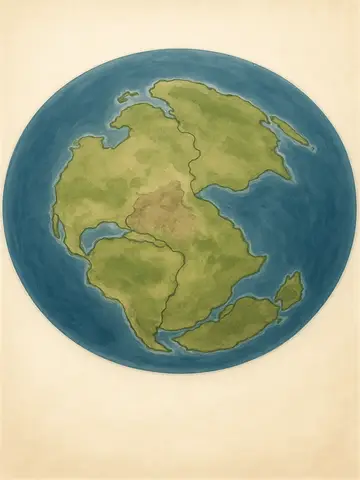
Geological Context and Formation of the Pangée Supercontinent
About 335 million years ago, during the end of the Carbonifera, most of the earth's emerging masses assembled to form the supercontinent called Pangea. This is the result of the gradual convergence of several major tectonic plates, including Laurussia in the west and Gondwana in the south. This process is part of a long geological cycle, marked by the fragmentation of the old continental masses and their recombination into new entities. The formation of Pangée was accompanied by intense tectonic activity, causing the birth of mountain ranges such as Appalachians and Hercynians. This unique geographical configuration has profoundly altered the oceans, reducing the size of marine basins and creating a global ocean called Panthalassa.
Consequences and impacts of the Pangée assembly -335 Ma
The assembly of Pangée has had a major impact on climate, biodiversity and geochemical cycles. Land concentration has led to an increase in continental areas distant from marine influence, favouring extreme climatic conditions, with very hot summers and harsh winters. This contributed to a depletion of marine and terrestrial biodiversity, eventually precipitating the great permian extinction. Geologically, the relative stability of this supercontinent influenced global ocean and atmospheric currents. This grouping also conditioned the future fragmentation of the Permian and the formation of the current continents. Related events include the formation of Hercynian mountain ranges (cause), the great extinction of the Permian (consequence), and the fragmentation of Pangée in Mesozoic (rupture). These transformations have long-term shaped the geological and biological history of the Earth.