


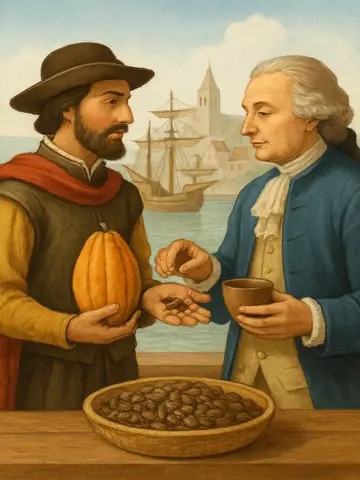
The introduction of cocoa in Europe in 1528 marks a major turning point in the cultural and commercial exchanges between the New World and the Old World, at the heart of the great Spanish explorations and conquests.
Historical and political context of the arrival of cocoa in Europe
At the beginning of the 16th century, Spain, newly enriched by the discovery and conquest of the Americas, sought to exploit the resources of the newly colonized territories. After the fall of the Aztec Empire in 1521, Hernán Cortés settled in Mexico, a region where cocoa was already a precious beverage, used by Indian elites. During the reign of Charles Quint, Spain dominated a large part of the New World and imposed its political and economic authority. This context of intensive colonization and trade opens the way for the introduction of cocoa, which will gradually be integrated into European crops.
Highlights and first uses of cocoa in 1528
The first documented arrival of cocoa beans in Europe dates from 1528, when the Spanish conquistadors returned. These beans, still unknown, are first used as a bitter drink, often mixed with spices like vanilla or chili, according to the Aztec tradition. Quickly, cocoa arouses interest in royal and aristocratic courts, especially in Spain, where it becomes a luxury product. This introduction coincides with the rise of transatlantic trade and provides the basis for the colonial economy based on the production and processing of exotic raw materials.
The introduction of cocoa in Europe in 1528 is thus a key step that illustrates the dynamics of cultural and economic exchanges between continents in the 16th century, announcing the development of a product that has become a must in world gastronomy.