


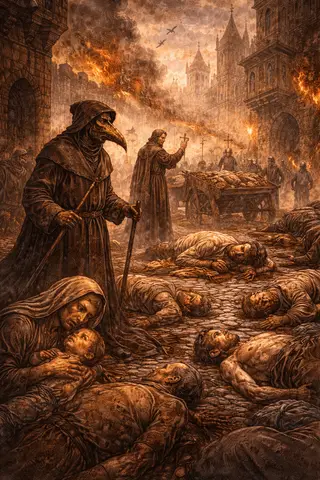
The black plague, which arrived in Europe in 1347, is one of the most devastating pandemics in human history. This disease, caused by the bacteria Yersinia pestis, quickly decimated a large part of the European population, deeply disrupting the social and economic structures of the time. Understanding its origins, spread and consequences makes it possible to better understand the extent of this medieval cataclysm.
Origins and rapid spread of black plague in Europe
The black plague originated in Central Asia, where it was circulating among animal and human populations before spreading along commercial routes. In 1347, it arrived in Europe via the Mediterranean ports, notably through the Genoese ships affected by the siege of the city of Caffa (now Crimea). Transported by fleas infesting rats, the disease spread at a staggering speed, first affecting the port regions of Italy, then spreading rapidly across the continent through trade and population movements. Within a few years, the black plague had reached almost every corner of Europe, taking millions of lives.
Social and economic impact of plague in 1347
The impact of the black plague on European society was profound and multifaceted. In terms of population, mass mortality led to a collapse of the population, with entire cities emptied of their inhabitants. This disaster caused a shortage of labour which upset social relations: the survivors, now in a position of strength, claimed better working conditions and higher wages, marking a turning point in medieval society. Moreover, fear and incomprehension with the disease fueled a wave of superstition, persecution (especially against minorities such as Jews), and a challenge to religious institutions. Economically, agricultural and artisanal production fell sharply, causing famine and crisis, but the scarcity of labour also led to innovation and a gradual transformation of medieval economic systems.
The black plague of 1347 remains a major historical event with consequences for decades. More than just a health disaster, it was a factor of profound change, changing the demographic, social and economic structures of medieval Europe. This dark episode recalls how epidemics can shape the destiny of civilizations.