


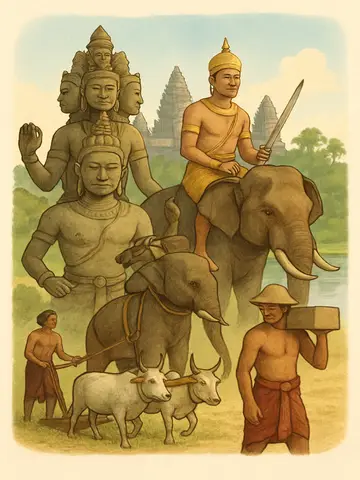
The Khmer Empire, famous for its monumental heritage and historical power, reached its peak well before the beginning of the sixteenth century. However, around 1500, it is interesting to examine the pivotal period when this empire still maintained a certain cultural and architectural influence, despite regional political transformations. This article explores this particular moment in Khmer history, highlighting its state at the dawn of the sixteenth century and its remarkable achievements.
The Khmer Empire at its height in the early 16th century
At the dawn of the 16th century, the Khmer Empire, although already through its golden age between the 9th and 15th centuries, still retains a significant presence in Southeast Asia. After the fall of its historic capital, Angkor, in the 15th century, the kingdom gradually moved to centres further south, especially around Phnom Penh. This transition reflects a period of political and social restructuring, when the empire tries to maintain its identity in the face of the rise in power of neighbouring kingdoms, such as the kingdom of Siam. Despite these challenges, Khmer culture remains vibrant, and the influence of its glorious past continues to permeate the region.
Cultural and architectural advances in 1500
Even though the great age of spectacular constructions like Angkor Wat belongs to the past, 1500 shows continuity in Khmer art and architecture. The temples of this time, though more modest, show a unique synthesis of traditional styles and external influences, including Indian and Buddhist. Khmer artisans continue to create complex bas-reliefs and refined sculptures, perpetuating a distinctive aesthetic tradition. Moreover, religion always plays a central role, with Buddhism becoming increasingly dominant, thus shaping the artistic and spiritual orientation of monuments and cultural practices.
At the turn of the 16th century, the Khmer Empire was undergoing a phase of transformation, marked by an adaptation to new realities without losing the traces of its extraordinary past. This period reveals the resilience of a civilization that, although far from its classical climax, continues to profoundly influence its cultural and architectural environment. The Khmer legacy of 1500 thus remains a precious testimony to the evolution of a great Asian civilization.