


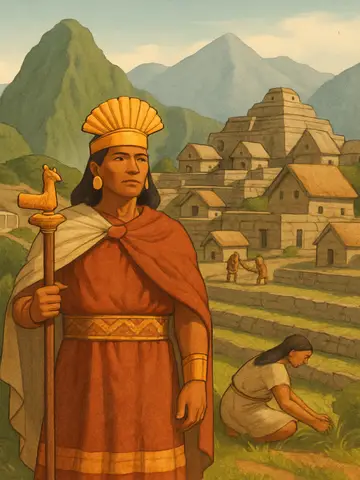
Inca civilization, which emerged in the Andes of Peru, reached its peak around 1500. At that time, the Inca Empire, known as Tawantinsuyu, extended over a vast region of South America and had a remarkable social and cultural organization. This period is characterized by an impressive territorial expansion and a structured society with sophisticated cultural practices.
The territorial expansion of the Incas around 1500
Around 1500, the Inca Empire extended for about 2,500 kilometres from present-day Colombia to central Chile. This rapid expansion was made possible by a well-organized army and effective military strategies, but also by skilled diplomacy that promoted the integration of conquered peoples. The Inca road network, about 40,000 kilometres long, facilitated communication and administrative control over this vast mountainous territory. This infrastructure also allowed the rapid movement of troops and the distribution of resources. The Incas imposed their language, Quechua, and their political systems to unify the different ethnic groups under one authority.
Inca society and culture at their summit
At the top of their power, the Incas had a hierarchical society where the emperor, or Sapa Inca, was considered a direct descendant of the Sun god. Inca society was structured around the family, the community group (ayllu) and the state, which organized agricultural production and distributed goods. Culturally, the Incas excelled in architecture, as evidenced by the city of Machu Picchu, and in crafts, including weaving and metallurgy. Their polytheistic religion, centered on the cult of the Sun, was linked to their vision of the cosmos and nature. Finally, their writing system, although not alphabetical, used quipus, tied cords to record complex information, demonstrating an advanced administrative organization.
At its peak in 1500, the Inca civilization was distinguished by a remarkable mastery of the territorial, social and cultural organization. Their empire, despite the diversity of the peoples it encompassed, managed to maintain a solid unity, a result of rigorous management and a rich culture. This period remains a fascinating testimony of the ingenuity and resilience of the Andean peoples before the arrival of Europeans.