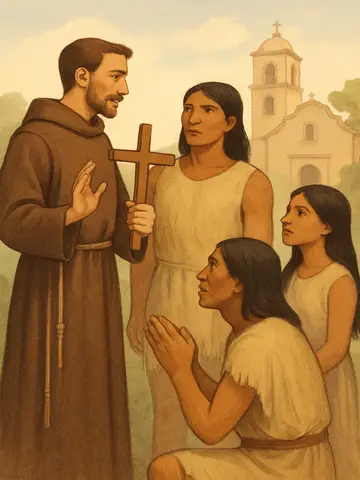
The year 1492 marks a pivotal date in world history, particularly with regard to the evangelization of Latin America. That year, with the discovery of the New World by Christopher Columbus, opened a new era in which the spread of Christianity would profoundly transform indigenous societies. The arrival of Europeans was not only a geographical event, but also a religious turning point that would have a lasting impact on the culture, politics and spirituality of an entire continent.
The Beginnings of Evangelization in Latin America
From the first contact with indigenous peoples, Spanish and Portuguese settlers undertook the mission of evangelizing local populations. This evangelization was often led by religious orders such as Franciscans, Dominicans and Jesuits, who quickly settled in conquered territories. Their aim was to convert Indians to Christianity, often through the construction of churches, the teaching of the Spanish or Portuguese language, and the establishment of schools. However, this dynamic was also marked by tensions and violence, as conversion was not always peaceful or consented.
The impact of 1492 on the spread of Christianity
The discovery of the American continent in 1492 has forever changed the world religious landscape. The expansion of Christianity beyond Europe was intensified by exploration trips, which were quickly followed by missionary campaigns. The Catholic Church found there a new fertile ground, with the support of the Iberian crowns who saw the conversion of indigenous peoples as a moral and political justification for colonization. This religious diffusion has helped shape Latin American cultural identities, where the Christian faith has often blended with local traditions to create unique religious expressions.
Thus evangelization in Latin America, initiated in 1492, was not only a religious phenomenon, but a complex and multifaceted process that profoundly marked the history of the continent. It left a lasting mark on indigenous societies, colonial institutions and popular beliefs, making Christianity a central element of modern Latin American culture. This encounter between two worlds is both a source of wealth and debate, testifying to the historical challenges of faith and conquest.