

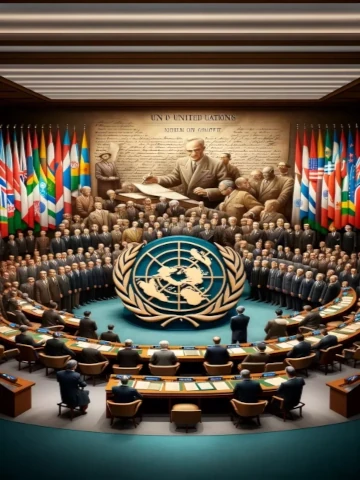
The creation of the United Nations (UN) in 1945 marks a major turning point in the history of international relations. After the horrors of the Second World War, the countries of the world felt the urgent need to establish an institution capable of promoting peace, security and international cooperation. This article reviews the origins of this organization and the key events that led to its official birth.
The origins and context of the United Nations
The UN finds its roots in diplomatic efforts during and after the Second World War to avoid the recurrence of global conflicts. As early as 1941, the Allies, including the United States, the United Kingdom and the Soviet Union, sought to establish a new international organization that would replace the League of Nations, which was deemed ineffective. The declaration of the Atlantic in 1941, signed by Churchill and Roosevelt, already expressed the desire to establish lasting international cooperation. The context of mass destruction, immense loss of life and heightened political tensions has strengthened the determination of nations to build a solid legal and institutional framework for global peace.
The San Francisco Conference and the signing of the Charter
In April 1945, the San Francisco Conference brought together 50 nations to develop the Charter of the United Nations. This diplomatic event was crucial because it made it possible to formalize the founding principles of the United Nations and define its major organs, such as the Security Council, the General Assembly and the International Court of Justice. The Charter, adopted on 26 June 1945, sets out the organization's objectives: to maintain peace, to ensure collective security, to respect human rights and to promote economic and social cooperation. The official signing took place on 24 October 1945, which is now celebrated as United Nations Day, marking the beginning of a new diplomatic era based on collaboration and dialogue.
The establishment of the United Nations in 1945 was an essential response to the challenges of the twentieth century, providing an international framework for conflict prevention and human development. Despite its limitations and criticism, the UN remains a key player in global diplomacy. Its history recalls the importance of cooperation among nations in building a more peaceful and equitable future.