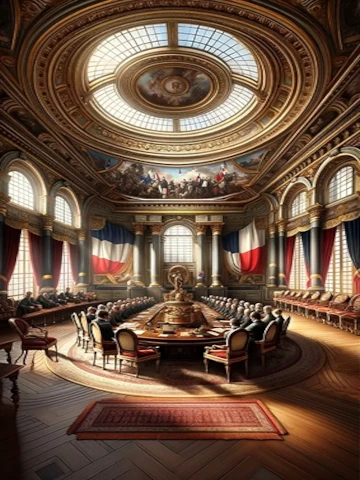


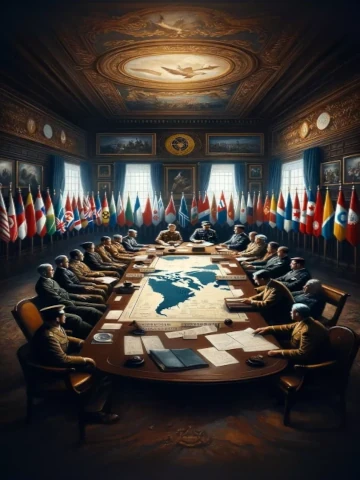
The Treaty of Versailles, signed in 1919, is one of the most famous peace agreements in modern history. It marks the official end of the First World War, a devastating conflict that has profoundly disrupted political and territorial balances in Europe. This treaty, negotiated mainly between the victorious Allies and defeated Germany, had major consequences, both diplomatically and geopolitically, shaping the twentieth century.
Historical context of the Treaty of Versailles in 1919
The First World War, which began in 1914, confronted the great European powers in a deadly conflict that lasted more than four years and caused millions of deaths. With the Armistice signed on November 11, 1918, it became urgent to define the conditions for peace in order to avoid a new war. The Treaty of Versailles negotiations took place in Paris under the leadership of the main winners: France, Great Britain, the United States and Italy. The debate was marked by tensions, particularly between US President Woodrow Wilson, who advocated a just peace based on his « Fourteen Points »and the French and British leaders, who wanted severe sanctions against Germany responsible for the conflict.
Major political and territorial consequences
The Treaty of Versailles imposed strict conditions on Germany: loss of important territories such as Alsace-Lorraine returned to France, demilitarization of the Rhineland, drastic reduction of its army, and payment of heavy financial reparations. At the political level, the Treaty contributed to the weakening of the Weimar Republic and fostered a feeling of humiliation and revenge in Germany, which will be exploited by Nazism. In addition, the Treaty has redesigned the map of Europe with the creation of new states such as Czechoslovakia and Yugoslavia, but also through the dissolution of the Austro-Hungarian and Ottoman empires. Despite its peace objectives, the Treaty of Versailles remains criticized for sowing the seeds of a future global conflict.
In summary, the Treaty of Versailles of 1919 represents a major turning point in contemporary history. Although he ended World War I, his punitive clauses against Germany and the territorial changes imposed created lasting tensions. The Treaty thus illustrates the complexity of building lasting peace after a major conflict and underlines the importance of diplomatic negotiations in preventing future wars.