

The Armistice of the First World War, signed on November 11, 1918, marks the effective end of the fighting that ravaged Europe for more than four years. This agreement puts an end to a conflict of unprecedented magnitude, which has profoundly affected societies, borders and mentalities. More than just a ceasefire, Armistice symbolizes the hope of lasting peace after the horrors of the Great War.
Historical Context of the Armistice of 1918
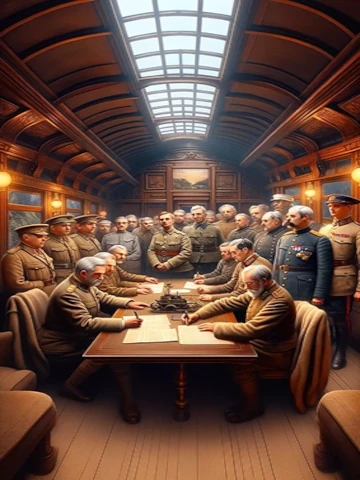
The First World War, which began in 1914, quickly turned into a deadly and static conflict, mainly between the allied powers and the central empires. After several years of an exhausting war of trenches, the moral, economic and military exhaustion of the belligerents was palpable. In 1918, allied offensives reinforced by the United States' entry into war reversed the balance of power. Germany, faced with internal revolts and a military collapse, sees its leaders seeking to negotiate an end to hostilities. It is in this context that the Armistice is concluded in the clearing of Rethondes, aboard the restaurant car of Marshal Foch, chief of the Allied armies.
Major consequences of the end of the Great War
The Armistice paved the way for the Treaty of Versailles, signed in 1919, which redraws the map of Europe and imposes harsh conditions on defeated Germany. Humanly, millions of soldiers and civilians pay a heavy toll, with considerable losses lastingly affecting societies. Politically, the end of the war led to the fall of several empires – Austro-Hungarian, Russian, Ottoman – and the birth of new states. Moreover, this historic moment arouses a deep desire for peace and reflection on the need to avoid future conflicts, inspiring the creation of the League of Nations. However, unsolved tensions and the legacy of war already herald the challenges ahead of the twentieth century.
The Armistice of 11 November 1918 remains a major milestone in world history, a symbol of the end of a devastating war but also the beginning of a period of reconstruction and questioning. While offering a welcome truce, it has also laid the foundations for a new fragile world order, whose repercussions are still being felt today. Each year, this date is commemorated to honour the memory of the victims and to recall the importance of peace.