


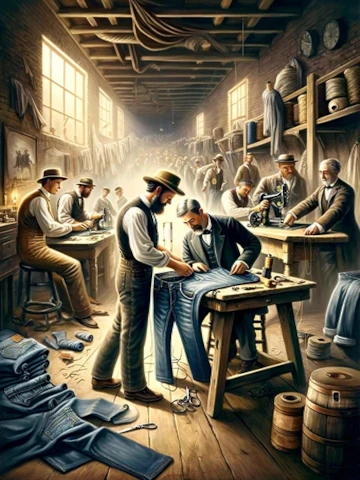
Jean is today a universal garment worn by millions of people around the world, symbolizing freedom, style and durability. Yet its history dates back to a specific time, in 1873, when this robust piece of fabric came into being. Understanding the origins of jeans makes it possible to appreciate not only its impact in the world of fashion, but also its role in the evolution of working clothing.
The origins of jeans: a revolutionary invention
Jean is not just a garment, it is an ingenious response to the needs of 19th century workers. At that time, workers, miners and cowboys were looking for durable pants that could withstand the difficult conditions of their daily work. The denim canvas, woven in a tight manner, offered exceptional robustness. But it's the idea of adding copper rivets to the tension points that really revolutionized this garment. This innovation has strengthened the areas most sought after, making trousers almost indestructible. These features have made jeans ideal work equipment, long before it became a fashion symbol.
1873: The birth of an iconic garment
The year 1873 marks a major step with the obtaining of a patent by Levi Strauss and Jacob Davis for this new form of reinforced pants. Levi Strauss, a fabric merchant, and Jacob Davis, a tailor, collaborated to create this innovative garment for workers in the U.S. West. Their invention quickly achieved commercial success, thanks to its robustness and practicality. The name « jeans » comes from the city of Genoa, Italy, where this type of fabric was originally made. Since then, the denim has ceased to evolve, moving from a simple utilitarian garment to a must in popular world culture.
The invention of jeans in 1873 is much more than just a historical anecdote: it was the beginning of a textile revolution that transformed our way of dressing. From its practical origins to its iconic status, jeans embody a perfect fusion between functionality and aesthetics. Even today, it continues to inspire creators and adapt to trends, while remaining faithful to its robust roots. In celebrating this invention, we also celebrate the ingenuity and adaptability of a garment born to last.