


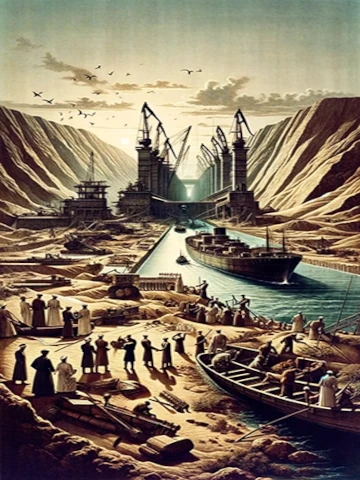
The opening of the Suez Canal in 1869 was a landmark moment in 19th-century maritime and industrial history. This waterway, linking the Mediterranean Sea to the Red Sea, has revolutionized world trade by considerably reducing distances between Europe and Asia. Back to a colossal construction site and an inauguration that marked an era.
The colossal construction of the Suez Canal in the 19th century
The project to build the Suez Canal, carried mainly by French engineer Ferdinand de Lesseps, was an exceptional project for his time. Launched in 1859, the site mobilized tens of thousands of workers under often difficult conditions. The desert and arid nature of the region, as well as the technical problems of water management and digging, were major challenges. Yet, thanks to technological innovations and a rigorous organization, the canal could be dug over a distance of about 160 kilometres, transforming a geopolitical ambition into a tangible reality.
Inauguration and historical impact in 1869
The official inauguration of the Suez Canal took place on 17 November 1869 in the presence of many international personalities, testifying to the global importance of this new seaway. The canal offered a direct route between Europe and Asia, reducing shipping by several thousand kilometres and thus promoting trade between continents. Its opening also marked a strategic and political turning point, influencing relations between major powers and enhancing colonial interest in the region. The Suez Canal quickly became a vital axis for maritime transport, symbolizing modernity and human capacity to reshape geography to meet the world's economic needs.
The opening of the Suez Canal in 1869 is more than just a technical achievement: it represents a decisive step in the history of international trade and in the transformation of the global geopolitical landscape. Today, this passage continues to be an essential link in global trade, reflecting the vision and determination of those who led this off-the-shelf project.