

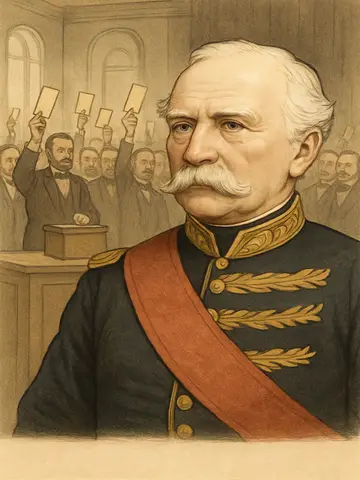
Patrice de Mac Mahon is an emblematic figure of 19th-century French political history. His election to the presidency of the Republic in 1873 marked a decisive turning point in the consolidation of the republican regime after a period of war-stricken instability and deep political tensions. This article describes the circumstances of his election and his decisive role in the stabilization of the Third Republic.
The election of Mac Mahon's Patrice as president in 1873
In 1873, France had barely emerged from the Franco-Prussian war and the Paris Commune, events that had profoundly weakened the country and questioned the sustainability of republican institutions. It was in this context that Patrice de Mac Mahon, a French marshal respected for his military role and conservative politician, was elected President of the Republic on 24 May 1873. His election was largely supported by monarchists and conservatives, who saw him as a leading figure capable of restoring order while maintaining some continuity in governance. Mac Mahon, faithful to his convictions, embodied a temporary compromise between the nascent Republic and the supporters of a return to the monarchy, thus allowing a more peaceful political transition.
Mac Mahon's role in stabilizing the Republic
Once president, Patrice de Mac Mahon played a central role in the stabilization of the Republic. Aware of the deep divisions that were going through French society, he sought to ease tensions between moderate republicans and royalists, fostering a more serene political climate. Despite his monarchistic sympathies, he respected the new republican constitution and tried to make institutions work in a spirit of balance. Its mandate was marked by the consolidation of administrative and parliamentary structures, which allowed the Republic to gain legitimacy. However, his attachment to certain conservative values sometimes led to friction, particularly during the episode of « Sixteen May » in 1877, which illustrates the limits of his policy. However, Mac Mahon is widely recognized for laying the foundations for a stable Republic that will continue.
The election of Patrice de Mac Mahon to the presidency in 1873 was a key moment in French political history, a symbol of the search for a balance between different forces present after a period of crisis. Through his authority and moderation, he contributed effectively to the stabilization of the Third Republic, fostering a climate conducive to the consolidation of republican institutions. His mandate, although marked by tensions, remains a fundamental step for modern France, between military heritage and political commitment to the service of the nation.