

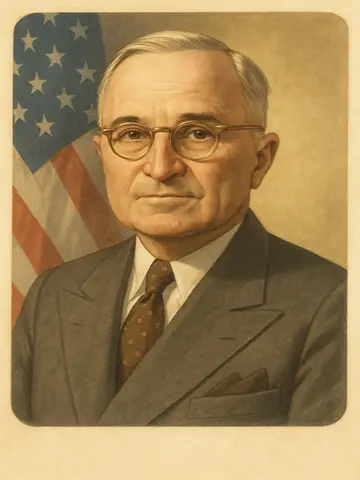
Harry S. Truman became President of the United States in an extremely turbulent world context in 1945. Its rise to power marked a crucial turning point not only for America, but also for world history. This article explores his accession to the presidency that year and the major challenges he faced from the beginning of his term.
Harry S. Truman's accession to the presidency in 1945
Harry S. Truman assumed the presidency of the United States on 12 April 1945, following the sudden death of Franklin D. Roosevelt. For only 82 days, Truman had been a catapult at the head of a country plunged into World War II. His appointment was unexpected, as Roosevelt had chosen in part for political reasons related to Missouri, but Truman still lacked experience in international affairs and the high spheres of power. Nevertheless, he soon knew how to impose and embrace his new responsibilities, determined to continue the war efforts and prepare for the post-war period.
Major Challenges During Truman's 1945 Presidency
The first months of Truman's presidency were marked by unprecedented challenges. The war in Europe was coming to an end, but the fight against Japan in the Pacific continued. Truman faced the crucial decision to use the atomic bomb, a new and terrifying weapon, to speed up the end of the conflict. He also supervised the transition to peace, with the creation of the United Nations and the first tensions of what would become the Cold War. Internally, he had to manage the expectations of a nation exhausted by war, while laying the foundations for economic and social reconstruction. These initial months forced his image as a pragmatic and resolute leader.
The year 1945 was decisive for Harry S. Truman, who went from a secondary role to that of head of state in the midst of world turmoil. His rapid accession to the presidency and his management of major crises set the stage for a presidency that would profoundly mark American and international history. Truman proved to be a president capable of bold decisions in extraordinary times, setting the tone for decades to come.