


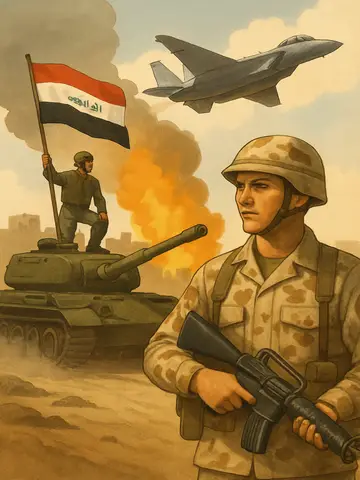
The Gulf War, which began in 1991, is a major episode of the twentieth century, mixing geopolitical, economic and military issues in the heart of the Middle East. This conflict between an international coalition led by the United States and Iraq, following Iraq's invasion of Kuwait. This first major post-Cold War confrontation marked a turning point in Western military interventions and had lasting consequences for the region.
Historical background and causes of the 1991 conflict
The historical context of the Gulf War is deeply rooted in the economic and territorial tensions in the Middle East. In August 1990, Iraq, led by Saddam Hussein, invaded Kuwait, a small neighbouring State rich in oil resources. The invasion was motivated by several factors: Iraq's debts during the Iran-Iraq war, disputes over oil production and accusations of plundering Kuwaiti resources. The international community quickly condemned this aggression, fearing a major destabilization in a region vital for global energy supply. The United Nations demanded the immediate withdrawal of Iraqi troops and imposed severe sanctions, thus paving the way for military intervention.
Military operations began in the Gulf War
The official beginning of the Gulf War military operations took place in January 1991, with the launch of Operation Desert Storm. This massive air campaign lasted several weeks, aimed at weakening Iraqi forces and destroying their strategic infrastructure. The international coalition, composed mainly of the United States, the United Kingdom and other allied countries, used advanced military technology, including precision air strikes and night bombardments. The offensive was followed by a short but intense ground phase in February 1991, which allowed the liberation of Kuwait in just a few days. This rapid and effective operation demonstrated the technological and strategic superiority of Allied forces, while limiting human casualties.
The beginning of the Gulf War in 1991 showed how geopolitical issues in the Middle East could mobilize the international community around concerted military action. This conflict not only marked the end of Iraq's territorial expansion, but also laid the foundations for Western intervention in the region for decades to come. While the war has allowed the liberation of Kuwait, it has left many political and humanitarian issues outstanding, paving the way for fragile terrain for future tensions.