


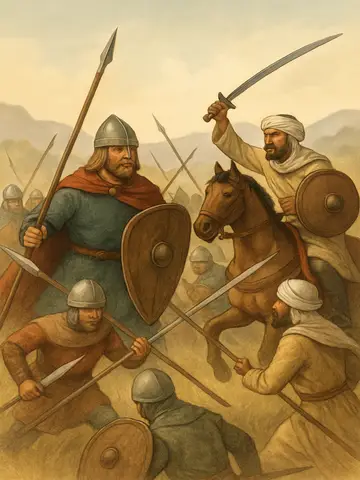
The Battle of Poitiers, also known as the Battle of Tours, took place in 732 and marks a crucial turning point in Europe's history. Opposing the French forces led by Charles Martel to the expanding Umayyad armies, this confrontation had a profound impact on the political and religious configuration of the continent. This battle is often seen as a key moment that has slowed Muslim expansion in Western Europe.
Historical context of the Battle of Poitiers in 732
At the beginning of the eighth century, the rapid expansion of Muslim armies from the Iberian peninsula to the north of Europe raised great concern among the Christian kingdoms. After the conquest of Muslim Spain, the Omayyads continued their advance towards the French lands. Charles Martel, mayor of the palace and military leader of the Franks, took the decision to oppose this progression in order to protect his territories and maintain the balance of power in Western Europe. The Battle of Poitiers is thus part of a confrontation between two worlds with opposite religious and cultural visions.
Major consequences of Charles Martel's victory
Charles Martel's decisive victory in Poitiers had lasting effects on European geopolitics. On the one hand, it stopped the Muslim expansion to the north, thus ensuring the preservation of Christianity in Western Europe. On the other hand, this success enabled Charles Martel to considerably strengthen his authority and that of the Carolingian dynasty, paving the way for the ascent of Charlemagne. Finally, the battle had an important symbolic significance, consolidating the idea of a united Christian Europe against the external threat, a concept that will influence European politics for centuries.
The Battle of Poitiers remains a major event that shaped the fate of medieval Europe. Thanks to Charles Martel's determination and the resistance of the Franks, this victory not only hampered a military invasion but also allowed the consolidation of a European cultural and religious identity. Even today, this battle is celebrated as a key moment in the construction of European history.