


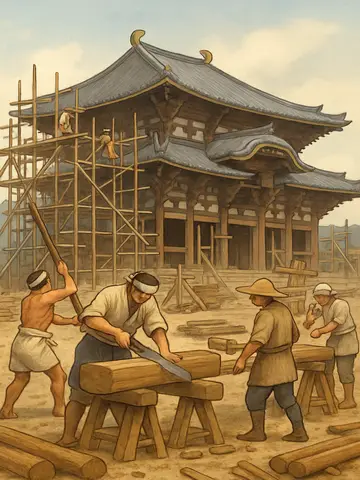
Tōdai-ji: When Faith Builds an Empire
In 752, Emperor Shōmu inaugurated in Nara the world's largest Buddhist temple, housing a 15 metre bronze Buddha. The gesture is both religious and political — As Constantine built St.Sophie, or Louis XIV raising Versailles, Shōmu built in stone what he wanted to affirm in power.
The context is that of a fragile empire. The smallpox epidemics of 735-737 killed up to a quarter of the population, rebellions shook the provinces. Shōmu, sincerely Buddhist, responds to the crisis as Ashoka had done in India a thousand years earlier: sacralizing imperial authority. The network of provincial temples which he decrees in 741 — on kokubunji — In reality, there is a central government, linking each province to the capital.
The realization owes everything to two men: the monk Rōben, spiritual director of the project, and Gyōki, a popular figure who mobilizes the provinces where the imperial decree is not enough — a role comparable to that of Bernard de Clairvaux in the development of European Gothic cathedrals.
The human cost is real: peasant chores, forced mobilization of resources. This paradox — building a temple of compassion in suffering — will cross the history of the great religious monuments, from pyramids to the Sagrada Família.
Reconstructed after the 12th century civil wars, Tōdai-ji remains today the largest wooden structure in the world. A thousand two hundred and seventy years after its foundation, it bears witness that no great civilization has ever separated faith from power.
To go further
Mikael Adolphson, Edward Kamens & Stacie Matsumoto (ed.) — Heian Japan, Centers and Peripheries (2007) Replaces the Tōdai-ji in the long term of Japanese state Buddhism, from the origins to the Heian era.
Ivan Morris — The World of the Shining Prince (1964) The classic reference on the civilization of Nara and Heian, accessible and richly contextualized.