


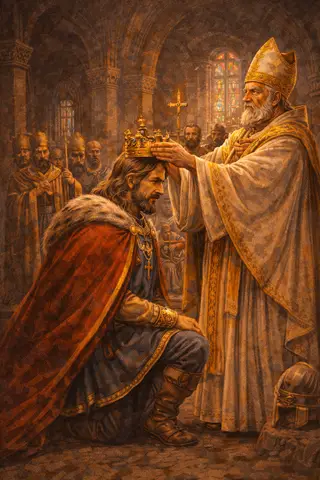
Charlemagne in the year 800 is a major event in medieval European history. Couroned emperor by Pope Leo III in Rome, Charlemagne embodies the political and cultural renaissance after the fall of the Western Roman Empire. This solemn act marks the revival of the Empire in the West, which later inspired the Holy Roman Empire, and seals an alliance between religious power and temporal power. To understand the importance of this moment, it is essential to put this event in its historical context and analyse its long-term consequences.
Historical context of Charlemagne's creek in 800
At the end of the eighth century, Western Europe was fragmented into kingdoms derived from the heritage of the Germanic peoples. Charlemagne, king of the Franks since 768, has been able to extend its territory by a series of military conquests and campaigns, uniting much of the ancient Gaul, Germania and Italy. Its power has been strengthened through effective administration and promotion of culture, particularly with the Palatine School. In addition, Pope Leo III, confronted with political threats in Rome, sees Charlemagne as a potential protector of the Church. It is in this context of mutual needs that on 25 December 800, during a Mass in Saint Peter of Rome, Charlemagne was crowned emperor by the pontiff, marking a symbolic break with the past and affirming the rebirth of a Christian empire in the West.
Meaning and impact of the imperial crown
Charlemagne is much more than just a religious ceremony: it is a fundamental political act that legitimizes imperial authority through divine blessing. By receiving the crown from the pope's hands, Charlemagne was recognized as the successor of the Roman emperors, giving a new sacramental dimension to his reign. This event also marks the beginning of a lasting alliance between the imperial throne and the papacy, the foundation of medieval European politics. In addition, the priesthood reaffirms the idea of a united Christian empire in the West, which will profoundly influence politics, culture and religion for centuries. Finally, this act reinforces the centrality of Rome as the spiritual capital of the Christian West, thus consolidating the legitimacy of the sovereigns through an unavoidable religious dimension.
To sum up, Charlemagne's 800-year sacre is a crucial historic milestone that has redefined the relationship between political and religious power in Europe. Charlemagne, by its imperial crown, inaugurates a new era marked by the imperial and Christian renaissance, whose repercussions will pass through the ages. This event symbolizes the desire to restore an old order in a renewed form, laying the foundations of the Holy Roman Empire and affirming the central role of Christendom in European governance.