


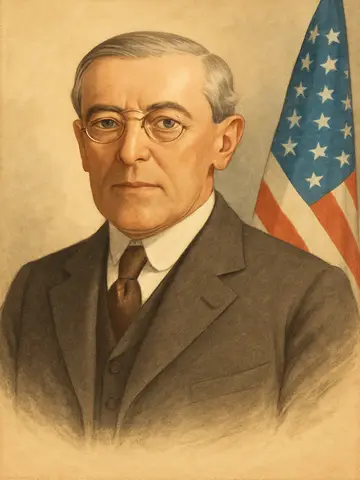
Woodrow Wilson is an emblematic figure in American political history, whose election to the presidency in 1913 marks a decisive turning point for the United States. As soon as Wilson came to power, he undertook a series of major reforms aimed at modernizing the country and strengthening economic and social regulation. Its mandate begins in a context of profound change, where citizens' expectations for fairer and more effective governance are particularly strong.
Woodrow Wilson: Beginning of his historic presidency in 1913
Woodrow Wilson's election in 1912 and his assumption of office in March 1913 symbolize the advent of a new political era in the United States. A representative of the Democratic Party, Wilson embodies a progressive and reformative vision, carried by his slogan of « New State » (New Freedom). His presidency began in a climate of great economic and social instability, with an American society undergoing industrial transformation. Wilson is working quickly to restore confidence in institutions and reform a system dominated by large companies, while seeking to strengthen workers' rights and consumer protection.
Major reforms launched by Wilson in 1913
From his first year in office, Woodrow Wilson introduced fundamental reforms that marked his time. Key measures include the creation of the Federal Reserve, a central bank to stabilize the US economy and regulate credit. Wilson also promotes the Federal Trade Commission (FTC) Act to combat unfair trading practices and monopolies. Its administration also introduced Underwood-Simmons tariff reform, which reduced tariffs and introduced a progressive federal income tax, thereby strengthening tax justice. These initiatives demonstrate Wilson's desire to impose stricter control over large corporations and to promote balanced economic development.
The year 1913 was probably one of the most important in Woodrow Wilson's presidency, as it laid the foundations for a profound transformation of American politics. Through his bold reforms, Wilson imposed himself as a determined progressive leader to modernize the country and protect the interests of the people against economic powers. Its action in 1913 had a lasting impact on the political and economic landscape of the United States, marking the beginning of a historic presidency that would shape the 20th century.