


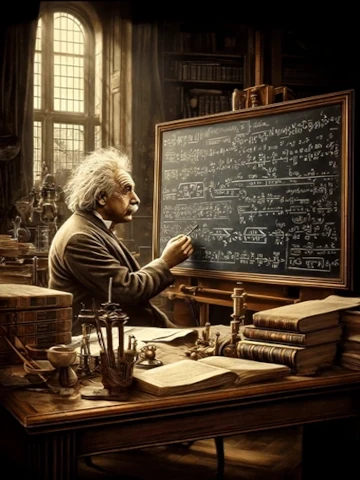
The theory of relativity, presented in 1915 by Albert Einstein, revolutionized our understanding of the universe. By proposing a new way of designing space, time and gravity, this theory challenged the classical notions inherited from Newton and paved the way for modern physics. This article explores the historical context that led to this major discovery and the fundamental principles behind it.
Historical context of relativity theory
At the beginning of the twentieth century, classical physics, dominated by Newton's laws and Maxwell's electromagnetism, seemed unable to explain certain observed phenomena, particularly those related to light and high-speed body movement. By 1905 Einstein had already upset the scientific world with his theory of restricted relativity, which established that the laws of physics are the same in all inertial repositories and that the speed of light is constant. Yet this theory did not take into account gravity. It was in this context that ten years later, in 1915, Einstein presented his theory of general relativity, a new theory of gravitation that would profoundly alter our vision of the universe.
Fundamental principles explained in 1915
Einstein's theory of general relativity is based on the idea that gravity is not a traditional force, but a manifestation of space-time curvature caused by the presence of matter and energy. Unlike Newtonian gravity, where force acts remotely, Einstein proposes that moving objects follow curved trajectories in a distorted space-time. This reformulation explains phenomena that classical physics could not, such as the precession of Mercury's perihelion or the deviation of light by gravity. The 1915 theory also relies on the principle of equivalence, affirming that the effects of a gravitational field are locally indistinguishable from those of acceleration. With this theory, Einstein offered a more complete and accurate description of cosmic reality.
The theory of general relativity, formulated in 1915, remains a cornerstone of contemporary physics. It not only deepened our understanding of gravity but also opened up new perspectives for astrophysics, cosmology and technology. More than a century after its publication, its predictions continue to be verified and its implications continue to inspire modern scientific research.