

The Great Russian Revolution of 1917 represents a major turning point in the history of the twentieth century, marking the end of the Tsarist Empire and the beginning of a new political era under the communist regime. This event upset not only Russia, but also the global balance, deeply influencing politics, the economy and society. Understanding the roots of this revolution and the crucial role of the Bolsheviks is essential to grasp the magnitude of this historical change.
The root causes of the Great Revolution of 1917
The 1917 revolution was rooted in an accumulation of social, economic and political tensions. Russia, under the reign of Tsar Nicholas II, was facing a serious economic crisis aggravated by the First World War. The Russian army suffered devastating defeats, undermining the morale of both soldiers and civilians. Moreover, social inequalities were staggering: an immense majority of peasants and workers lived in poverty while the nobility and bourgeoisie enjoyed considerable privileges. The autocratic regime, not concerned with democratic aspirations and social demands, was unable to bring about reforms. These explosive conditions led to growing discontent, leading to demonstrations, strikes and mutinies, paving the way for a revolution.
The key role of the Bolsheviks in taking power
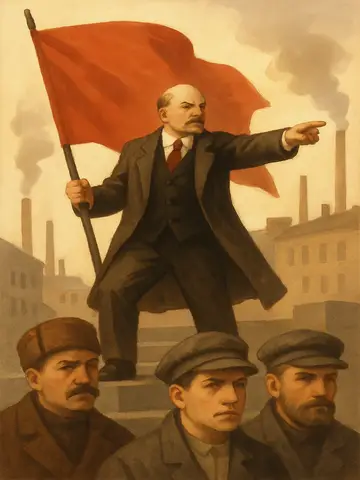
The Bolsheviks, led by Vladimir Lenin, played a decisive role in the seizure of power in 1917. This Marxist revolutionary party, advocating the rapid fall of capitalism and the establishment of a Soviet government (workers' and peasants' councils), was able to mobilize the masses frustrated by war, poverty and lack of freedoms. Their slogan « All power to the Soviets » Resonated strongly in a troubled Russia. After the fall of the Tsar during the February Revolution, the provisional government led by Kerensky failed to meet popular expectations, notably by keeping Russia in the global conflict. Taking advantage of this, the Bolsheviks organized the October insurrection, taking over the main power centres in Petrograd. Their ability to structure an armed revolution, to control the Soviets and to promise peace, land and bread allowed them to impose a new regime, thus laying the foundations of the Soviet Union.
The Great Russian Revolution of 1917 was much more than just a change of government. It embodied the radical break with an autocratic regime and the emergence of a political ideology that would influence the entire world. By analysing the root causes that led to the uprising and the determining role of the Bolsheviks, we understand better how a society in crisis can be transformed by determined revolutionary forces. This revolution remains a fundamental chapter in understanding the challenges and aspirations of the modern world.