

The assassination of François-Ferdinand in 1914 was a major event of the early twentieth century, often considered as the trigger of the First World War. A heir to the Austro-Hungarian throne, François-Ferdinand was fatally wounded in an attack that would upset the fragile balance of European powers. This article explores the historical context of this assassination and its immediate consequences for European policy.
Historical context of the 1914 assassination
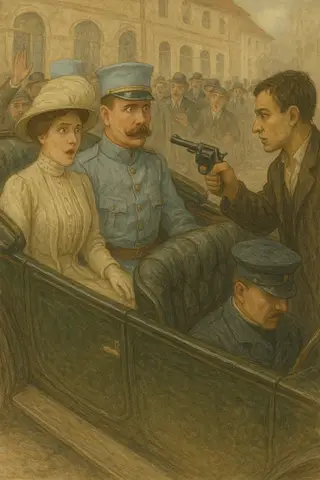
At the beginning of the twentieth century, Europe was a continent in full tension, divided into complex military alliances and marked by heightened nationalist rivalries. The Austro-Hungarian Empire, of which François-Ferdinand was the heir, faced independent movements, notably in Bosnia and Herzegovina, an area annexed in 1908 but claimed by Serbia. On 28 June 1914, during an official visit to Sarajevo, François-Ferdinand and his wife Sophie were murdered by Gavrio Princip, a Serb nationalist member of the secret group « The Black Hand ». This violent act reflected not only local tensions, but also the fragility of an international system ready to break out.
Immediate consequences for European policy
The assassination of François-Ferdinand provoked a chain reaction that precipitated Europe into war. The Austro-Hungarian Empire, supported by Germany, addressed a severe ultimatum to Serbia, which Serbia could not fully accept. This escalation led to the mobilization of military alliances: Russia supporting Serbia, France and Britain preparing to defend their interests, while Germany declared war on Russia and then on France. In a few weeks, this local conflict degenerated into a world war, marking a decisive turning point in modern history. The assassination was therefore much more than just an isolated act, it was the drop of water that overflowed a vase already full of political and military tensions.
The assassination of François-Ferdinand remains a symbolic event whose repercussions profoundly affected the twentieth century. By triggering the First World War, he changed the world order, redefined borders and permanently influenced international politics. Understanding this historical moment means understanding how an individual act can, in a tense context, bring about a global transformation with dramatic consequences.