


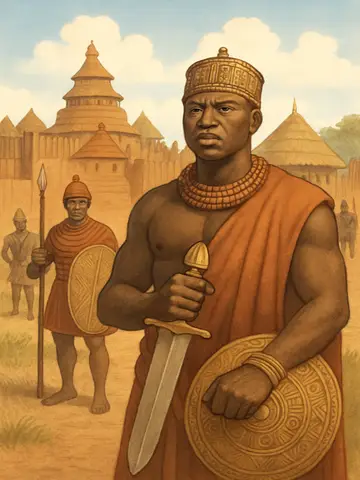
Historical and geopolitical context of the Kingdom of Benin around 1500
At the turn of the 16th century, the Kingdom of Benin, located in the present south of Nigeria, established itself as a major regional power. Founded around the 12th century, this Yoruba kingdom achieved notable political stability under the Oba dynasty, with a centralized monarch holding absolute authority. Geopolitically, Benin controls an extensive commercial network, linking the interior of West Africa to the Atlantic coast, where a first contact with Portuguese explorers begins. This period is marked by a hierarchical social organization, strong institutions and a well-structured army, ensuring defence and territorial expansion. The general climate of West Africa at that time was that of an intensification of trans-Saharan and Atlantic exchanges, fostering inter-kingdom interactions and the circulation of goods, ideas and techniques.
Political, economic and cultural peak at the beginning of the 16th century
Around 1500, the Kingdom of Benin reached its peak thanks to a centralized administration under the Ozolua and its successors, which strengthened both royal power and internal cohesion. Trade becomes an economic pillar, notably with the sale of ivory, bronze objects, weapons and slaves to the Portuguese. This commercial opening generates an increased wealth, allowing considerable artistic investments, illustrated by the famous production of bronze plates and brass sculptures, symbols of royal power and technical mastery. At the same time, Beninese society develops complex legal codes and a very structured cult of ancestors, which reinforce the legitimacy of the state. These transformations bear witness to a civilisation that is both diplomatic and warlike, capable of adapting to new regional dynamics. The Beninese climax is part of a broader context of expansion of African kingdoms in the face of the arrival of Europeans, prelude to the profound changes in Atlantic trade and international relations in the sixteenth century.