


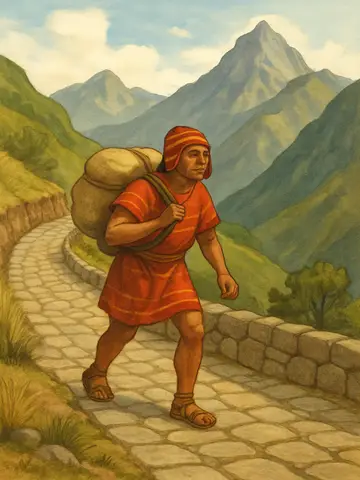
The Qhapaq Ñan road network, developed around 1500, represents a major technical and organizational feat of the Inca Empire. This vast system, extending over 30 000 km across the Andes, linked the different regions of the empire, thus facilitating governance, trade and communication. His study provides a better understanding of the political and cultural integration of this pre-Columbian civilization.
Historical and geographical context of the Qhapaq Ñan network
In the 15th century, during the reign of Inca Pachacútec, the Inca Empire expanded rapidly through the Andes, encompassing the current territories of Peru, Ecuador, Bolivia, Chile and Argentina. Complex mountain geography requires an effective communication system to maintain imperial unity. The Qhapaq Ñan, literally « great way » in Quechua, is then designed to overcome these natural obstacles and connect political, religious and economic centers.
Construction, functions and impacts of the Inca road system
The Qhapaq Ñan consists of paved roads, suspended bridges and relays called tambos. Its construction mobilized an organized workforce, using techniques adapted to the rugged terrain. This network allowed the rapid movement of messengers (chasquis), armies and agricultural resources. Politically, it strengthened inca domination by facilitating administrative control and integration of conquered populations. Economically, it promoted interregional trade and the redistribution of goods, contributing to social cohesion and the prosperity of the empire.
Historical links
The Qhapaq Ñan prefigures imperial infrastructures developed in other civilizations, such as the Via Appia of Rome. Its construction is directly linked to the political centralization undertaken by Pachacútec, a process comparable to the organization of royal roads under Charlemagne. After the Spanish conquest in the 16th century, these roads were used by the colonists for their colonial administration, illustrating the continuity of their strategic importance. Their contemporary study helps to better understand pre-Columbian engineering and Andean social organization.