


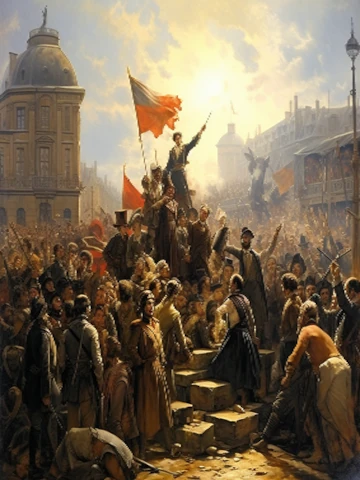
The February 1848 Revolution in France was a major event marking the end of the July monarchy and the advent of the Second Republic. This revolution, fuelled by deep social and political tensions, led to a radical transformation of the French electoral system with the establishment of universal male suffrage. This article explores the underlying causes of this revolution as well as the historical significance of the establishment of universal suffrage in France.
The root causes of the February 1848 Revolution
The February 1848 Revolution was rooted in a combination of economic, social and political crises. The July monarchy, under Louis-Philippe, is seen as a bourgeois monarchy far removed from popular concerns. The economic crisis of 1846-1847, marked by unemployment and the growing poverty of the working class, exacerbated social tensions. Moreover, the regime restricts the right to vote to an affluent minority, excluding the vast majority of citizens, thus fuelling strong democratic discontent. Republican and socialist ideas spread rapidly, demanding more social justice and wider political participation. Faced with these pressures, the revolt broke out in February 1848, putting an end to the monarchy and paving the way for democratic reforms.
The introduction of universal suffrage in France
One of the first steps taken by the Provisional Government of the Second Republic is the establishment of universal male suffrage. This revolutionary reform increases the right to vote from a few thousand censored voters to several million men, without condition of fortune or social status. Universal suffrage is seen as a means of legitimizing the new regime and rooting democracy in France. It also symbolizes a major step forward in French political history, since it introduces a direct and extensive participation of citizens in political life. However, although this universal suffrage paves the way for greater inclusion, it remains limited to men, still excluding women from the electoral process, an inequality that will persist until the 20th century.
The February 1848 Revolution and the establishment of universal male suffrage represent a decisive turning point in French political history. They demonstrate a deep will for social and democratic transformation, while stressing the limits and contradictions of a revolution in the midst of construction. This period marks the beginning of a new era in which the people become actors in their political destiny, laying the foundations for future democratic struggles.