


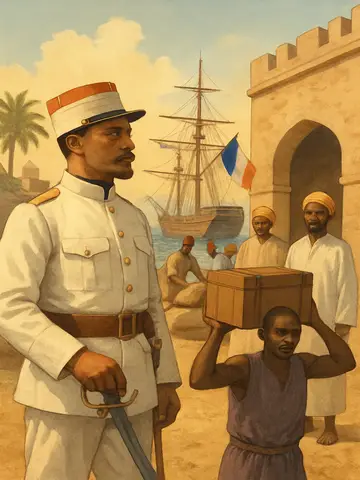
In the early 1920s, France pursued an ambitious colonial expansion policy, consolidating and expanding its empire in Africa and Asia. This period is part of a global context marked by the consequences of the First World War, where European powers sought to strengthen their economic and political influence on colonized territories. French colonial expansion, motivated by strategic, economic and cultural interests, has profoundly affected African and Asian societies, giving rise to complex dynamics still perceptible today.
Historical context of French colonial expansion in 1920
After the end of World War I, France intensified its efforts to establish its control over its colonies, both in Africa and Asia. The French colonial empire already included vast territories in West Africa and Equatorial Africa, as well as possessions in Indochina, including Vietnam, Cambodia and Laos. This period was also marked by the assumption of the mandate of the League of Nations on Syria and Lebanon, thus strengthening the French presence in the Middle East. France regarded these territories as essential to its economic power, because of their natural resources, but also as places where it could spread French culture and strengthen its international prestige.
Impact of the French presence in Africa and Asia
The French footprint on these territories was multiple and ambivalent. In Africa, infrastructure such as roads, railways and ports were developed, often serving the economic exploitation of resources and administrative control. In Asia, particularly in Indochina, colonization imposed profound social and economic transformations, with the establishment of a French-language education system and the stimulation of certain agricultural productions destined for export. However, this domination also generated strong local resistance, with the emergence of nationalist movements calling for independence and the end of colonial tutelage. At the cultural level, the French presence left a lasting trace, especially through language and institutions, but it also caused tensions and identity conflicts.
French colonial expansion in Africa and Asia in the 1920s was a crucial phase of imperial affirmation, combining political consolidation, economic exploitation and cultural diffusion. While it contributed to the rise of France as a world power, it also led to many contradictions and conflicts that deeply marked colonized societies. These legacies continue to influence relations between France and its former colonies, reflecting the historical importance of this period.