

In 1848, France went through a period of great political upheaval. The February Revolution overturned the July monarchy, paving the way for the establishment of the Second Republic. In this context of uncertainty and hope, the presidential election of December 1848 marked a major turning point with the arrival in power of Louis-Napoleon Bonaparte, nephew of Napoleon I. His election symbolizes both the desire for stability and the desire for renewal for a nation seeking leadership.
The election of Louis-Napoleon Bonaparte in 1848
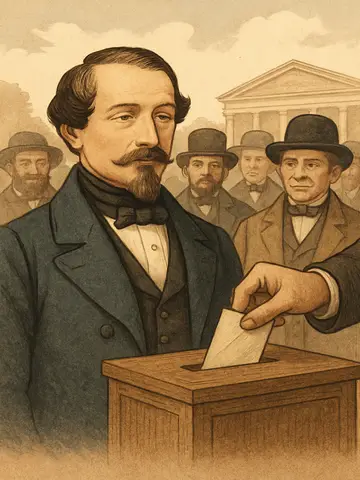
The presidential election of 10 December 1848 saw Louis-Napoléon Bonaparte largely win against his competitors. With a huge popularity linked to his name and his uncle's imperial aura, he won over 74% of the vote, a plebiscite that reveals the deep attachment of the French to the Napoleonic heritage. Its programme, combining social order, defence of the popular classes and promise of a strong power, finds a favorable echo in a country marked by social and political tensions. This brilliant victory enshrines Louis-Napoleon's accession to the Republic's first executive post.
New President for the Second French Republic
The arrival of Louis-Napoléon Bonaparte as President embodies a new era for the Second Republic. Its popular popularity gives it rare legitimacy, but it is also accompanied by considerable challenges, including the management of democratic aspirations and authoritarian temptation. His presidential mandate is seen as a pivotal moment when Republican institutions must find their balance in the face of a man whose political ambition is beyond the strictly presidential framework. In the end, his election turned the Republic into a regime that, despite its democratic foundations, would pave the way for the Empire.
The election of Louis-Napoleon Bonaparte in 1848 represents much more than just a change of president: it symbolizes the search for a political model capable of associating order and progress in a still fragile France. By embodying the hope for a restoration of the national grandeur, Louis-Napoleon imposed a new dynamic on the Second Republic, whose consequences would be lasting in the history of France. This crucial moment thus prefigures the profound transformations to come, between Republic and Empire.