


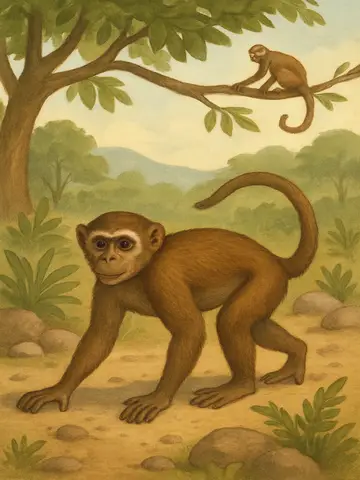
About 45 million years ago, during the Middle Eocene, the Earth experienced a much warmer climate than today. Large tropical forests covered much of Africa and Asia, providing an ideal environment for the evolution of many tree mammals. It is in this context that some of the early ancestors of modern monkeys appear, an important step in the history of primates.
Primates had already existed for several million years, but around 45 million years some groups began to develop more advanced characteristics. Fossils such as Eosimias, discovered in Asia, show features similar to future anthropoids, the group that later gave birth to monkeys, great monkeys and humans.
Tree life then plays an essential role in this evolution. To move quickly between branches, these primates develop a frontal vision improving the evaluation of distances, as well as prehensile hands capable of accurately grasping branches and fruits. Their fingers become more agile and their eyes gradually move forward of the face, providing a better vision in relief.
Their diet is also changing. While some ancestors were mostly insectivorous, these new primates adopted a more varied diet consisting of fruits, leaves and sometimes small animals. This food diversification promotes brain development and more complex behavior.
Over the course of millions of years, these first anthropoids will diversify into several major lines. Some will lead to the monkeys of the Old World in Africa and Asia, others to the monkeys of the New World in South America, while a particular branch will give birth to the great monkeys and then to the hominids, the group to which the human being belongs.
The study of this period now allows scientists to better understand how climate change, the forest environment and anatomical adaptations have shaped the evolution of primates. The fossils found in Africa and Asia show that the history of our lineage is the result of a slow, progressive and deeply linked evolution to the transformations of the planet.