

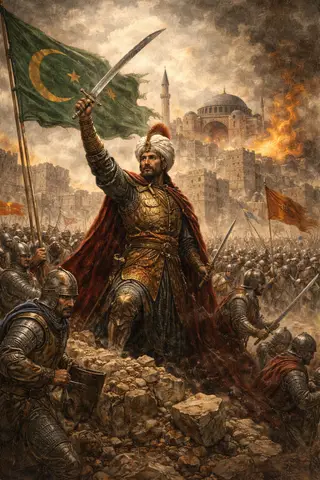
Constantinople's capture in 1453 marked a major turning point in world history. This event not only brought an end to the Byzantine Empire, but also transformed the geopolitics of the Mediterranean and paved the way for Ottoman expansion. A review of the historical circumstances and military strategies that led to the fall of this mythical city.
Historical context of the capture of Constantinople in 1453
Constantinople, capital of the Byzantine Empire, was for centuries a stunning fortress, strategically located between Europe and Asia. However, in the 15th century, the Byzantine Empire was considerably weakened by centuries of internal wars, external pressures, and the reduction of its territory. On the other hand, the Ottoman Empire, under the reign of Mehmed II, was expanding and sought to impose itself as the dominant power of the region. The capture of Constantinople represented for Mehmed II not only a strategic necessity to control commercial and maritime routes, but also a symbol of Ottoman supremacy over the Christian world.
The decisive military strategies at headquarters in 1453
The siege of Constantinople in 1453 was marked by remarkable military innovation. Mehmed II deployed gigantic cannons, including the famous giant bomb designed by the engineer goldsmith Urban, capable of destroying the imposing Byzantine walls. At the same time, the Ottomans put in place a maritime blockade thanks to their powerful fleet, preventing any reinforcement or refuelling of defenders. On the ground, the Ottoman army, with tens of thousands of men, has multiplied the constant assaults to exhaust Byzantine forces. The use of tunnels, firearms and the perfect coordination between the various military units has broken the resistance. After several weeks of fierce siege, the Ottomans finally managed to open a breach in the walls and seize the city.
The capture of Constantinople in 1453 upset the course of history. It ended more than a millennium of Byzantine domination and established the Ottoman Empire as an undeniable power. This event also marked the end of the Middle Ages and the beginning of a new era, announcing profound changes in cultural, economic and political exchanges between the East and the West.