

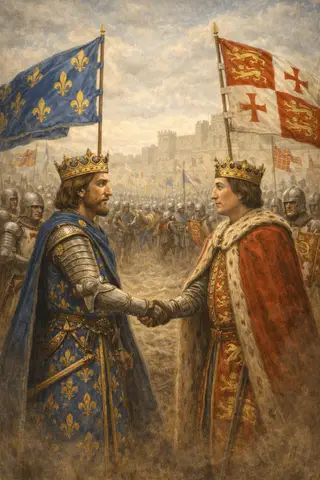
The Hundred Years' War, a major conflict between France and England that spread from 1337 to 1453, profoundly marked European medieval history. After more than a century of intermittent fighting, this long war ended definitively in 1453, putting an end to a tumultuous period of dynastic and territorial rivalries. Two key elements illustrate this conclusion: the decisive battle of Castillon and its profound consequences for the two kingdoms.
Castillon's decisive battle in 1453
The Battle of Castillon, on 17 July 1453, was considered the last major battle of the Hundred Years War. This battle opposed the French army, led by Jean Bureau, artillery expert, to the English forces commanded by John Talbot, one of the best English generals. Thanks to an innovative use of artillery, the French succeeded in breaking the English lines, inflicting a decisive defeat often seen as the actual end of the English presence in Guyenne. Talbot's death on the battlefield symbolized the end of an era of English domination over part of French territory, sealing the French victory.
Major consequences of the end of the Hundred Years' War
The end of the Hundred Years' War in 1453 had profound repercussions for both France and England. For France, it restored sovereignty over almost the entire national territory, promoted the unification of the kingdom and strengthened royal authority, especially during the reign of Charles VII. This success also contributed to the consolidation of a stronger national identity. On the other hand, England, losing its continental French possessions, found itself more isolated and soon faced internal unrest, including the War of the Two Roses. Thus, the conclusion of this long-term war reshaped the political and social map of Western Europe.
The Hundred Years War ended in 1453 with the French victory in Castillon, marking the end of a conflict that had shaken the kingdoms of France and England. Beyond the simple military conclusion, this end symbolized a major transition towards a more unified France and an England oriented towards its own internal challenges. The memory of this war remains a powerful testimony to the political, social and military transformations of the late Middle Ages.