

The Great Oxidation, which occurred about 2.4 billion years ago, marks a crucial step in Earth's history. This event corresponds to a significant and lasting increase in oxygen levels in the atmosphere, profoundly altering the global environment and life forms.
Geological and biological background prior to Great Oxidation
Prior to this period, the Earth's atmosphere consisted mainly of volcanic gases such as carbon dioxide, methane and nitrogen, with almost total absence of free oxygen. The oceans contained dissolved sulphides and life was dominated by anaerobic microorganisms, unable to use oxygen. However, there were cyanobacteria capable of oxygen photosynthesis, producing oxygen as a by-product, but this oxygen was rapidly consumed by chemical reactions with the minerals and gases present. Tectonics and intense volcanoism influenced atmospheric composition, now a reducing equilibrium.
Major environmental and evolutionary consequences of the event
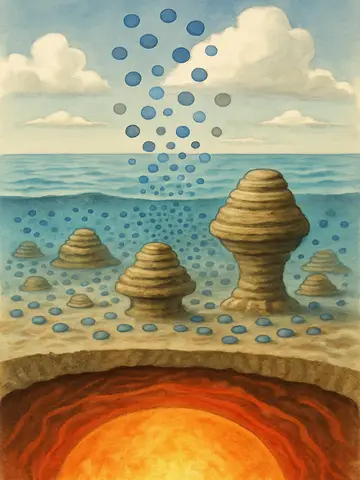
The accumulation of oxygen in the atmosphere caused oxidation of sulphides and iron, forming in particular the large belts of tapered iron. This transformation has made it possible to form an ozone layer, protecting the surface from ultraviolet radiation. Biologically, the presence of oxygen has led to the emergence of more effective aerobic metabolism, promoting the diversification and complexity of organisms. In addition, the Great Oxidation is linked to the first major glaciation (Huronian glaciation), caused by the reduction of greenhouse gases. This period also precedes the appearance of eukaryotes, the first complex organisms, preparing the ground for the subsequent evolution of multicellular life.
The Great Oxidation is thus a major pivot, permanently transforming the composition of the atmosphere and the living conditions on Earth. It lays the foundations for major biological and geological developments that will shape the future of our planet.