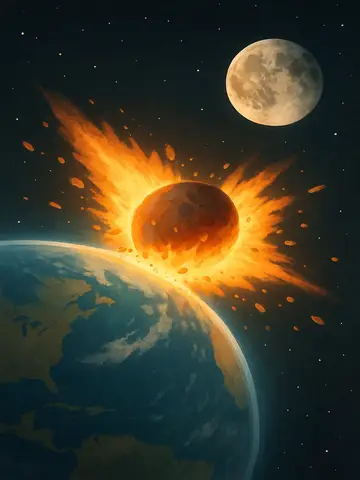
The formation of the Moon, about 4.51 billion years ago, remains a key event in the history of the solar system. This natural satellite, which illuminates our nights and influences the tides of land, was born at a time when our planet was still in youth. Understanding its origins not only illuminates the evolution of the Earth, but also the complex mechanisms that govern the formation of celestial bodies.
The mysterious origins of the Moon 4,51 billion years ago
The birth of the Moon dates back to a period when the solar system was still a protoplanetary disk filled with debris and molten materials. About 4.51 billion years ago, shortly after the formation of the Earth, a cataclysmic event upset this primitive environment. Lunar rocks and isotopic analyses show that the Moon formed rapidly from materials similar to those of the Earth. However, its exact origin remains engulfed in mystery, as extreme conditions and temporal decline make it difficult to accurately reconstruct.
Main Theories on Early Lunar Formation
Several theories attempt to explain the formation of the Moon, but the most widely accepted is that of the giant impact. According to this hypothesis, a body of Mars size, often called Theia, collided with the young Earth, ejecting a massive amount of debris into orbit. These fragments would then agglomerate to form the Moon. Other, less common models suggest capture of a wandering body or co-formation with the Earth. However, current evidence favours the giant impact, notably through the chemical similarity between terrestrial and lunar rocks.
The formation of the Moon 4,51 billion years ago marks a fascinating and complex chapter of cosmic history. Despite the mysteries that persist, scientific advances continue to reveal the mechanisms at work in this lunar genesis. Through this research, we better understand not only our natural satellite, but also the forces that shape planets and their environment in the universe.