

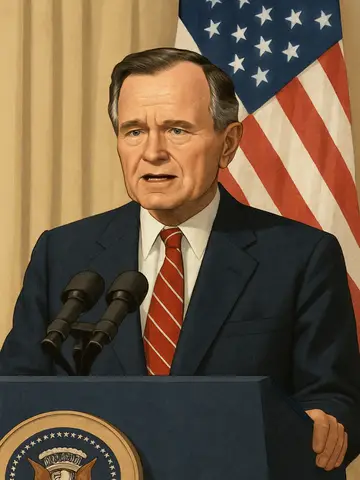
In 1990, following the end of the Cold War, US President George H. W. Bush introduced the concept of « New world order »a vision to reorganize international relations in a context of renewed peace and increased cooperation. This idea reflected the hope of a more stable world based on common rules and collaboration between great powers, while East-West bipolarity gave way to an unprecedented global order. This article looks back at George H. W. Bush's historical context and key speech, before analysing the founding principles of this New World Order.
Historical Context and Key Speech by George H. W. Bush
The year 1990 is characterized by major events that have profoundly affected the global geopolitical balance: the fall of the Berlin Wall in 1989, the imminent collapse of the Soviet Union and the end of the cold war. In this context, George H. W. Bush has repeatedly addressed the nation and the world to define a new approach to international relations. His most emblematic speech, delivered during the Gulf War, highlighted the idea of a world order based on respect for international law and multilateral cooperation. Bush stressed the importance of solidarity among nations in addressing global conflicts and challenges, while affirming the primacy of peace and collective security.
The founding principles of the New World Order in 1990
The New World Order formulated by George H. W. Bush was based on several essential pillars: the promotion of collective security, the defence of the sovereign rights of States, the maintenance of peace through international institutions such as the United Nations, and enhanced cooperation among the major Powers to prevent conflict. This framework also aimed at fairer regulation of economic relations and better integration of emerging countries into the global system. The underlying idea was to achieve a more stable global balance, based on legitimacy and shared responsibility, in order to avoid the major wars that had marked the twentieth century.
The wording of « New world order » by George H. W. Bush in 1990 marked a turning point in international diplomacy, proposing a collective and institutionalized vision for managing relations between states after the end of the cold war. While this idea has not always been unwavering in political reality, it has laid the foundations for a renewed international dialogue, seeking to combine peace, cooperation and respect for the rules. Today, the concept remains a major reference for understanding the hopes and challenges of the contemporary world order.