


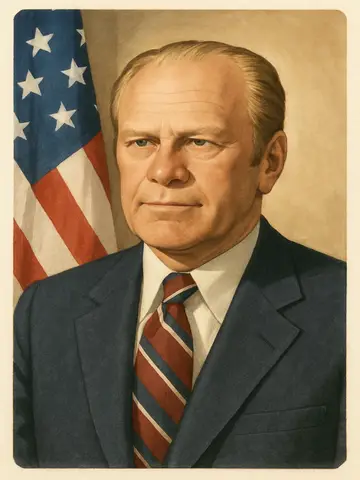
Gerald Ford became president of the United States in 1974, in a particularly turbulent period of American history. His accession to power took place in a context of political and social crisis, marked by the fall of Richard Nixon following the Watergate scandal. This article explores how Ford took up the presidency that year, as well as the main challenges he faced.
Gerald Ford: his rise to power in 1974
In August 1974, Gerald Ford became the 38th president of the United States after Richard Nixon's resignation, marking an extraordinary transition in American political history. Ford, then vice president, was the only one to hold this position after Spiro Agnew resigned in 1973. The appointment of Ford to the vice-chair, followed by the accession to the presidency, was validated by the 25th amendment, a procedure previously unprecedented. His arrival in power was therefore in full turmoil, with the difficult mission of restoring American confidence in their government.
The major challenges of President Gerald Ford in 1974
From the moment he took office, Gerald Ford faced a multitude of challenges, both domestic and international. At the national level, he inherited from a country deeply divided and shaken by the Watergate scandal, as well as by an economy in difficulty with galloping inflation. Ford also made the controversial decision to pardon his predecessor Nixon, a measure he defended as necessary to allow the nation to turn the page. On the international scene, Vietnam's war was coming to an end, and Ford had to manage the consequences of this conflict, while navigating in a context of the cold war, where tensions with the Soviet Union remained alive.
Gerald Ford took office in a climate of crisis, but his legacy is often associated with his role as a peacemaker, trying to stabilize a shaken country. His 1974 year was marked by difficult decisions and pragmatic leadership that helped shape the continuation of his US mandate and political history.