


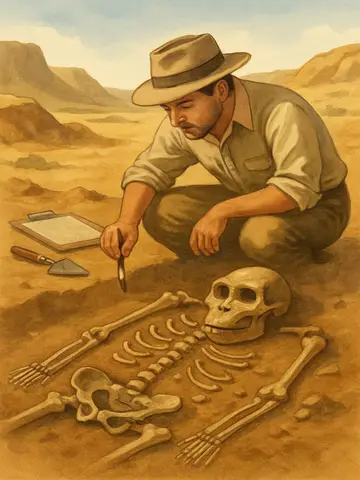
The discovery of Lucy, a multi-million-year-old Australopitheque fossil, marked a crucial milestone in the history of paleoanthropology. Reunited in 1974 in Ethiopia, this find has changed our knowledge of our origins and helped to better understand human evolution. Back to this historical discovery and its major scientific impact.
The historical discovery of Lucy, Australopitheque in 1974
In November 1974, the team led by Donald Johanson discovered the partial remains of a hominid in the Hadar region of Ethiopia. This fossil, nicknamed « Lucy » with reference to the Beatles song « Lucy in the Sky with Diamonds » which passed to the camp that day, belongs to the species Australopithecus afarensis. Dated about 3.2 million years ago, Lucy represents one of the oldest hominids ever discovered. Its partial skeleton, particularly well preserved, revealed essential characteristics: a biped posture confirmed by the structure of the pelvis and the lower limbs, while maintaining similar features in the skull and arms. This combination provided a valuable insight into the evolutionary transition between primates and modern humans.
Lucy's Impact on Understanding Human Evolution
Lucy's discovery profoundly changed the scientific vision of the human lineage. Before it, it was difficult to confirm the existence of hominids capable of walking standing while possessing archaic features. Lucy demonstrated that bipedism, one of the key characteristics of humans, preceded the development of a larger brain. This has allowed us to rethink the chronology and stages of human evolution, highlighting the importance of soil-adapted locomotion before increasing brain size. Moreover, its ancient age confirmed that our ancestors had already colonized different parts of Africa several million years ago, which prompted the researchers to intensify their excavations on this continent to better trace our history.
In short, Lucy's discovery in 1974 remains a cornerstone in the study of human evolution. This iconic fossil continues to inspire scientists and the general public, perfectly illustrating the complex steps that led to the emergence of modern man. Thanks to Lucy, our understanding of our origins has been enriched, paving the way for many further research and discoveries.