


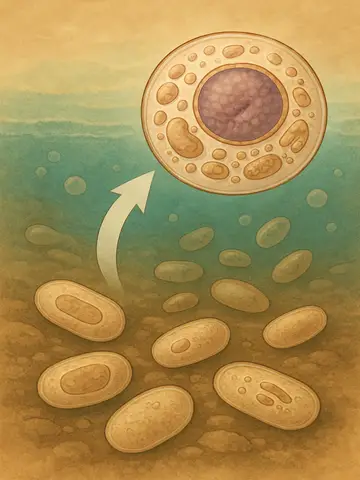
About 1.8 billion years ago, the Earth is going through a crucial phase in its biological history with the appearance of the first eukaryotic cells, marking a decisive step in the evolution of life.
Geological and biological context 1.8 billion years ago
At that time, the Earth was dominated by shallow oceans and an atmosphere poor in oxygen. Life consists mainly of simple prokaryotic cells, such as bacteria and archaeus, which appeared several billion years earlier. This period follows the Great Oxygenation Event (about 2.4 billion years ago), which gradually enriched the atmosphere with oxygen, a key factor for the complexification of living organisms. Plate tectonics begin to organize continents, influencing marine habitats where these first life forms evolve.
Emergence and role of the first eukaryotic cells on Earth
Eukaryotic cells, characterized by a delimited nucleus and specialized organelles, appear by endosymbiosis, a process in which one prokaryotic cell integrates another, giving birth to mitochondria. This innovation allows for more effective cellular respiration and greater structural complexity. These cells represent the first step towards the diversity of multicellular organisms, laying the foundations of plants, animals and fungi. Their emergence profoundly alters terrestrial biochemical cycles and paves the way for the subsequent evolution of more complex life forms.
Historical links
The appearance of eukaryotic cells is directly related to the Great Oxygenation Event, which allowed the availability of oxygen needed for aerobic breathing. It precedes the Cambrian explosion (about 540 million years ago), a moment of considerable diversification of complex animal life. Finally, this biological change also precedes the formation of the first supercontinents such as the Rodinia (around 1.3 to 0.9 billion years), which will influence environments conducive to evolution. These events form a continuity in the history of life, marking major breaks and progress in the complexification of organisms on Earth.