


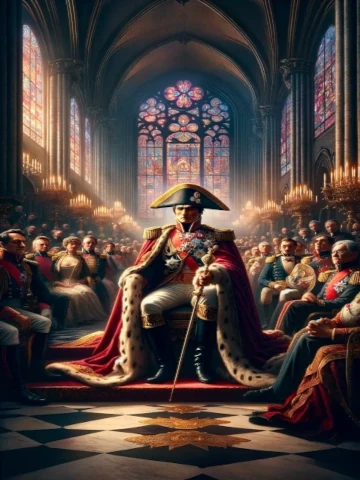
The crowning of Napoleon Bonaparte in 1804 was a key moment in French history, symbolizing the rise of the former general to the rank of emperor. This event was not only a political ceremony, but also an act full of significance, marking the transition between the French Revolution and the Empire, and reaffirming Napoleon's personal power while enshrined in a renewed monarchic tradition.
The historical context of Napoleon's coronation
At the beginning of the 19th century, France emerged from a tumultuous era marked by the Revolution of 1789 and the incessant wars resulting from it. Napoleon Bonaparte, thanks to his military successes and growing popularity, had succeeded in consolidating his power. In 1804 he decided to be crowned emperor, breaking with the Republic, but without returning to the traditional monarchy. This political choice was intended to legitimize its authority in the eyes of the French and European powers, in particular by establishing a stable and centralized regime after the years of instability.
The grandiose ceremony at Notre-Dame de Paris
On December 2, 1804, Notre Dame Cathedral in Paris was the scene of a sumptuous and meticulously orchestrated ceremony. In the presence of Pope Pius VII, Napoleon, dressed in a lavish imperial outfit, took the crown from the hands of the pontiff to pose himself, affirming his independence and supreme authority. This symbolic gesture marked a break with the tradition where the pope ran the sovereign, emphasizing the autonomy of his power. The ceremony was also an impressive spectacle, mixing fascist, religious rituals and demonstrations of power, intended to impress the court and the people.
Napoleon's crowning in 1804 remained an emblematic episode, illustrating the leader's desire to rise to the top of the political hierarchy while forging a new order. This ceremony, rich in symbols and meanings, bears witness to Napoleon's ability to combine tradition and innovation to establish his power. More than two centuries later, this event continues to inspire and fascinate, embodying the greatness and contradictions of a pivotal era in the history of France.