


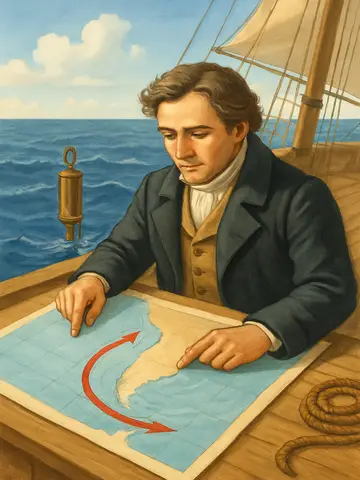
In 1803, during a revolutionary scientific expedition, German naturalist and explorer Alexander von Humboldt made a major discovery that would transform our understanding of ocean currents and their influence on marine ecosystems. This was the first systematic description of the cold current along the west coast of South America, now known as the Humboldt Current. This discovery had considerable implications not only for science but also for the navigation and economics of the coastal regions concerned.
The expedition of 1803 and the discovery of the current Humboldt
In 1803 Alexander von Humboldt undertook a scientific expedition to South America, during which he closely observed natural phenomena, including sea currents. By studying the waters along the coasts of Peru and Chile, he identified a cold sea current rising northward from Antarctica to the equatorial regions. This current, which strongly influenced water temperature and local climate, was first documented by its precise and rigorous observations. Humboldt realized that this current had a crucial role to play in regulating marine ecosystems, in particular by promoting a wealth of fish and nutrients in these areas. His discovery was a major scientific breakthrough that paved the way for studying the interactions between oceans and atmosphere.
Impact of the Humboldt Current on Marine Explorations
The discovery of the Humboldt Current had a considerable impact on 19th-century marine navigation and exploration. Knowing the existence of this cold current allowed sailors to better plan their routes by avoiding risk areas and taking advantage of its influence to facilitate certain journeys. Moreover, understanding this phenomenon was essential for the development of the fishing industries on the Pacific coast of South America, as the current favors a very rich marine biodiversity. The explorers and scientists who followed Humboldt relied on his work to deepen their research on ocean currents, contributing to better management of marine resources and significant advances in the natural sciences.
The discovery of the Humboldt current in 1803 by Alexander von Humboldt remains a key step in the history of marine science. By revealing the existence of a cold current structuring the ecosystems of the South Pacific, Humboldt not only enriched our scientific knowledge, but also made a lasting impact on maritime and economic practices in this region. Its scientific heritage continues to inspire researchers who are still studying the complex interactions between oceans, climate and marine life.