

In 1885, France as a whole gathered to pay tribute to one of its greatest writers, Victor Hugo. His death sparked a wave of deep emotion across the country, and the national funerals organized in his honour remained engraved in history as an exceptional moment of patriotic and literary gathering.
A solemn tribute to Victor Hugo in 1885
Victor Hugo's disappearance on 22 May 1885 upset the French nation. Known not only for his monumental literary work, but also for his political and humanitarian commitment, Hugo was an emblematic figure of the 19th century. His death was seen as the loss of a real national monument. As soon as the announcement was made, the government decided to hold a national funeral, an honour reserved for personalities who had deeply influenced French history and culture. This moment of recollection was the expression of unanimous respect, bringing together representatives of the people, artists, writers, but also thousands of citizens who came to witness their admiration and gratitude.
The historic ceremony of the national funeral
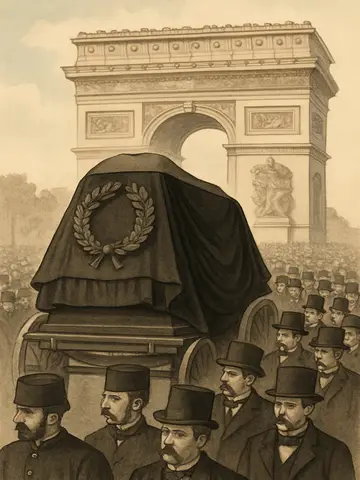
The funeral of Victor Hugo, held in Paris, was a rare ceremony. The funeral procession, several kilometres long, crossed the capital, allowing the population to deposit a final popular tribute. The burial took place at the Pantheon, a symbolic place where the great men of the French Republic were buried, highlighting Hugo's exceptional importance. During the ceremony, numerous speeches were given, celebrating man and writer, his universal work and his fight for justice and freedom. This historic day marked a turning point in the official recognition of writers in France and symbolized the union of citizens around the values defended by Victor Hugo throughout his life.
Victor Hugo's national funeral in 1885 remains a landmark episode in French cultural and social history. They show not only the immense respect for this exceptional man, but also the ability of a nation to unite to celebrate its heroes. Even today, this solemn tribute continues to inspire and recall the importance of collective memory in building national identity.