

The discovery of penicillin in 1928 marks a major turning point in the history of medicine. Before this advance, bacterial infections often represented a death sentence. This antibiotic, the result of incidental observation, has paved the way for effective treatments against many infectious diseases, revolutionizing health care around the world.
Incredible discovery of penicillin in 1928
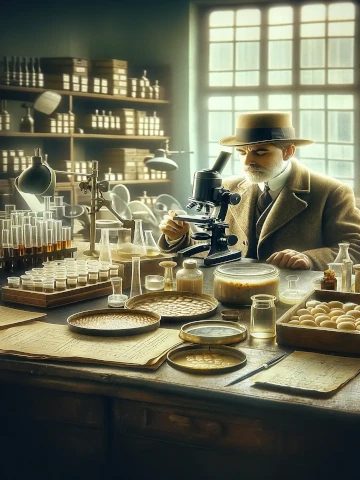
In 1928, in his laboratory at St Mary's Hospital in London, Alexander Fleming made an observation that would upset modern medicine. When examining petri boxes containing cultures of staphylococcal bacteria, he noticed that mould was accidentally developed on one of them and that around that mould, the bacteria were destroyed. This mould was a fungus of the genus Penicillium notatum, which produced a substance capable of inhibiting bacterial growth. Fleming baptized this substance « penicillin ». This unexpected discovery laid the foundation for antibiotics, drugs that would save millions of lives by effectively fighting bacterial infections.
Alexander Fleming: a revolutionary hit
Alexander Fleming, a Scottish microbiologist, was not specifically looking for an antibiotic when he made this discovery. His rigorous scientific approach and his sense of observation enabled him to understand the importance of what he had just seen. Despite a modest start, Fleming continued his research on penicillin, but it was only later in the 1940s that industrial production and the purification of penicillin were developed through the work of researchers such as Howard Florey and Ernst Boris Chain. Fleming was awarded the Nobel Prize in Physiology or Medicine in 1945 for this revolutionary discovery, recognized as a tremendous blow of luck that transformed modern medicine.
The discovery of penicillin in 1928 by Alexander Fleming illustrates perfectly how fortuitous observation, combined with curiosity and scientific perseverance, can change the course of history. This major breakthrough not only saved millions of lives, but it also inaugurated the age of antibiotics, which remains essential in the treatment of infections today. Fleming remains an iconic figure, a symbol of a medical revolution born of a simple stroke of luck.