


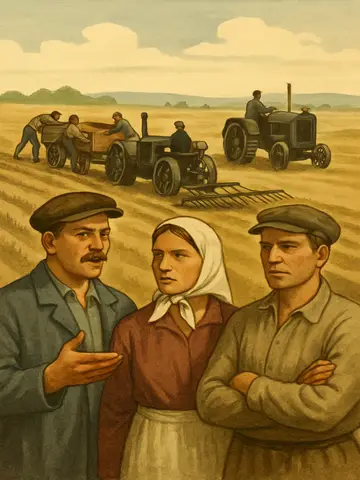
The collectivization of land in the USSR in 1929 marked a major turning point in Soviet agricultural and political history. Under the leadership of Joseph Stalin, this policy was aimed at radically transforming agricultural production by abolishing private ownership of land to establish collective farms, the kolkhozes. This has had a profound impact on rural society and the Soviet economy, in a context of rapid modernization and forced industrialisation.
Context and objectives of land collectivization in the USSR
In 1929, the USSR was still predominantly rural, with a traditional agriculture dominated by small landowners called kulaks. Faced with the need to increase agricultural production to feed the growing population and support industrialization, the Soviet government decided to collect land. The aim of this policy is to put an end to private farming, which is deemed to be retrograde and unequal, while allowing for a better organization of agricultural production. Collectivization is also part of a political will to strengthen state control over the countryside and to eliminate the resistance of the kulaks, perceived as enemies of the socialist revolution.
Social and economic consequences of collectivization 1929
Collectivization leads to profound social and economic changes, which are often brutal. Millions of peasants are forced to abandon their lands and tools to join the kolkhozes. The repression of the kulaks accused of sabotage causes deportations and executions. On the economic front, initial disorganization is important: agricultural production falls, causing famines and shortages, especially the great Ukrainian famine (Holodomor), which causes several million deaths. Despite these difficulties, in the long term, collectivisation allows for better mechanization of agriculture and centralisation of resources, thus contributing to the industrial objectives of the USSR. However, this process leaves a heavy legacy of human suffering and lasting social tensions.
The collectivization of land in the USSR in 1929 is therefore a key episode that illustrates both the economic and ideological ambitions of the Soviet regime and the human tragedies of an uncompromisingly imposed policy. Although it has enabled Soviet agriculture to be structured according to a collectivist model, it has also profoundly affected rural society, leaving scars difficult to heal. This historic moment remains a subject of debate on efficiency, human costs and the scope of forced transformations in the Stalinist USSR.