


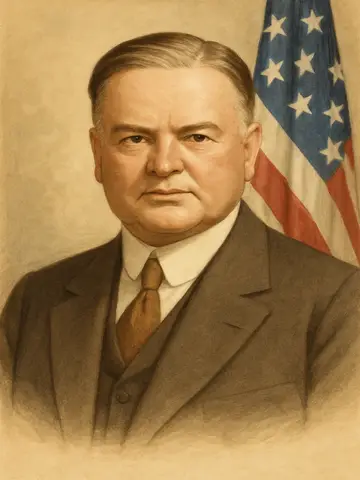
The election of Herbert Hoover in 1929 marked a turning point in the political and economic history of the United States. Hoover came to power with a reputation for efficiency and success as an administrator, carrying great hopes for the country. However, his mandate was quickly put to the test by dramatic events that would profoundly mark the nation.
Herbert Hoover: his election in 1929 and his promises
Herbert Hoover was elected President of the United States in November 1928, taking office in March 1929. A convinced Republican, he was seen as a national hero thanks to his humanitarian efforts during the First World War and his effective management of the Secretary of Commerce. Hoover campaigned for promises of continued prosperity, technological innovation and improved living conditions for all Americans. His message of optimism and confidence in economic progress attracted an electorate eager for stability after a decade of rapid growth.
Hoover's major economic challenges since 1929
Unfortunately, shortly after taking office, the stock market crash of October 1929 plunged the United States into an unprecedented economic crisis. Hoover was confronted with a deep depression, marked by the fall in industrial production, the massive closure of businesses and galloping unemployment. Despite his attempts to intervene through limited government measures, his policy was considered too cautious by many, and he struggled to contain the devastating effects of the crisis. This difficult period would have a lasting impact on its political heritage.
The election of Herbert Hoover in 1929 was thus inextricably linked to the beginning of the Great Depression, a key moment that redefined the role of the state in the American economy. Although his intentions and promises gave rise to hope, the dramatic circumstances turned his mandate into an almost insurmountable challenge. Hoover remains a complex historical figure, whose presidency illustrates the limits of political responses to a major economic crisis.