


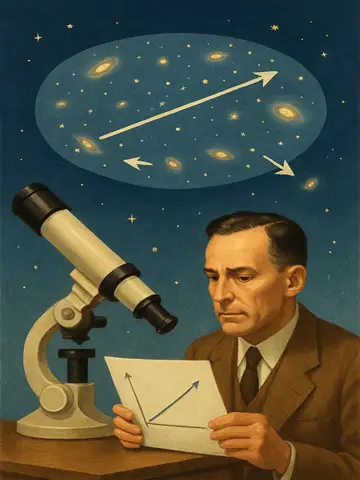
In 1929, a major breakthrough in the understanding of the universe was achieved through the discovery of Hubble's law. This law, formulated by American astronomer Edwin Hubble, profoundly transformed our vision of the cosmos by revealing that galaxies are moving away from each other at a speed proportional to their distance. This discovery laid the foundations of modern cosmology and paved the way for the study of the expansion of the universe.
The discovery of Hubble's law in 1929
By observing the red movements of galaxies, in 1929 Edwin Hubble established a linear relationship between the rate of recession of galaxies and their distance to Earth. Thanks to accurate measurements made with the Mount Wilson telescope, he found that the farther away a galaxy is, the more it seems to move away. This observation allowed us to understand that the universe is expanding, which contradicted the idea of a static cosmos widely accepted until then. Hubble's law is mathematically expressed by the formula v = H0 × d, where v is the rate of recession, d the distance, and H0 the constant of Hubble.
Impact of Hubble's Law on Modern Cosmology
Hubble's law revolutionized cosmology by providing tangible proof that the universe is not immutable, but dynamic and expanding. This discovery led to the development of the Big Bang model, which describes the origin and evolution of the universe from an extremely dense and warm state. Moreover, Hubble's constant has become one of the fundamental values for estimating the universe's age and size. Contemporary research continues to build on this law to refine our understanding of black matter, black energy and the forces that govern cosmic expansion.
Hubble's law, discovered in 1929, remains one of the cornerstones of contemporary cosmology. By demonstrating that the universe is expanding, Edwin Hubble has opened a new era in the study of space and time, profoundly influencing physics and astronomy. Even today, his work inspires scientists who seek to penetrate the deepest mysteries of the universe.