

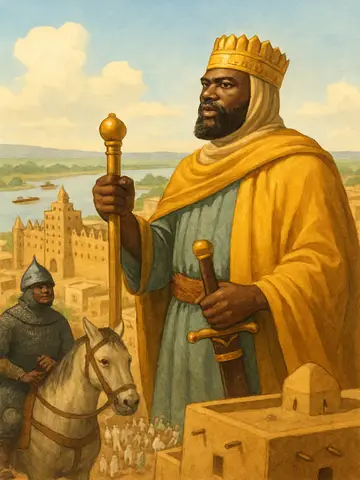
The Songhai Empire, one of the largest empires in West Africa, reached its peak in almost 400 years. This remarkable civilization has been imposed by its military power, its political organization and its cultural influence. Back to this flourishing period that marked the history of the African continent.
The climax of the Songhai Empire: an African Power
The Songhai Empire reached its peak between the 15th and 16th centuries, extending over a vast region from the Niger River to the Sahara. Under the reign of iconic leaders such as Sonni Ali and Askia Mohammed, the empire was affirmed as a dominant power in West Africa. Its capital, Gao, has become a key centre for trade, politics and culture. The Songhai Empire has mastered key strategic territories and trade routes, promoting gold, salt and other valuable resources that have enriched the entire region.
The keys to success during the 400 years of prosperity
The longevity and prosperity of the Songhai Empire was based on several essential factors. First, a strong military organization has been able to defend and expand its borders against external threats. Secondly, the establishment of an efficient administrative system, with a well-defined hierarchy, has promoted internal stability. Moreover, the flourishing trade, facilitated by the geographical position of the empire, contributed to its enrichment. Finally, support for the arts, Islamic culture and education has strengthened the identity of the empire and its regional influence. These combined elements allowed the Songhai Empire to last for almost four centuries, leaving a lasting legacy in African history.
The Songhai Empire is an emblematic example of the greatness of African civilizations before colonization. Its peak period, spanning about 400 years, is a testament to an organized, prosperous and influential society. Understanding this story also means recognizing the richness and complexity of the African continent through the ages.