


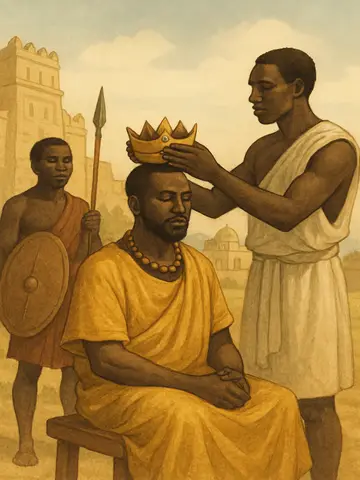
Before the birth of the Empire of Ghana around the year 300, the region between the Senegal River and the Niger River was populated by nomadic and semi-nomadic groups, organized in small chiefdoms. This area, rich in natural resources, is crossed by commercial routes linking North Africa with the Sahelian and Sudanian regions. Local people practice agriculture, livestock and trade, including gold and salt, essential goods that will shape the future power of the region. Geography favours the emergence of a centralized power capable of controlling these exchanges, in a context marked by the rise of neighbouring empires, such as the Aksoum empire in Ethiopia and the Mediterranean cities-states.
The empire of Ghana was founded around 300 years ago by the Soninkés, a mandated people who established a monarchical political system centered on the city of Koumbi Saleh. This foundation is the result of the gradual consolidation of local chiefdoms under the authority of a king, called Ghana, which means « warrior » or « King » in their language. This royal power is based on the control of trans-Saharan trade routes, where the south-eastern gold meets the salt of the Sahara. Ghana established a structured administration, linking rural populations to urban and military centres, and developed an army capable of defending its interests against external incursions.
The empire of Ghana plays a crucial role in the development of trade between sub-Saharan Africa and the Mediterranean world. Its control of gold resources stimulates long-distance trade and promotes the enrichment of elites. In the medium term, this power inspires the formation of other Sahelian empires, such as Mali and Songhai, which resume and amplify its political and economic model. In addition, the Ghanaian-controlled Trans-Saharan trade route is part of a broader dynamic, integrating the Islamic expansion after the 7th century, which profoundly influences culture and religion in the region. Thus, the founding of the Empire of Ghana around 300 marks the beginning of an era of state organization and prosperity that will long-term shape the history of West Africa.